Showing posts with label politics. Show all posts

Thursday, April 2, 2015

Military Corruption

Strategy Page has an important article on a form of military corruption that is growing in the US. Unfortunately, some people don't seem to intuitively get how the phenomenon of micromanagement on the field of battle is corrupt and the article doesn't lay out its "j'accuse" thesis clearly enough to make it clear to all. Senior military officials and politicians are offloading their career risk of something bad happening in the field by stretching out the OODA loop of combat troops. This increases the chance that people die and a given combat mission fails. Protecting the career of a president or a flag rank officer with the blood of some private out in the field is corrupt, offensively so. Even if nobody dies and the cost is merely extending a firefight by half an hour, that is half an hour extra that the team is playing the PTSD game of russian roulette. There is no cost free way to micromanage. There are just ways to do it that are visibly cost free for the people in DC.

Here's the comment I put at the article:

We know that delays getting wounded to medical care increase deaths beyond what is unavoidable. The "golden hour" is something that has been identified as a metric that is important and that's right and proper. But micromanagement kills too and that appears not to be as universally recognized with no metrics to track it and blame to apportion when it happens. It is stretching out the combatants OODA loop which increases the chance we lose or at least take greater casualties than otherwise necessary. 
We need to measure the phenomenon and attach consequences to the abuse. The computing power needed to do this is available. When command knows that there is a timer going on every time they stick their nose in and that their names will attach to casualties caused by their intervention, the problem of micromanagement will shrink because we will have a feedback loop to punish those who engage in inappropriate intervention. 
The fact that we have not embedded this feedback loop and are increasing the risk enlisted and junior officers take unnecessarily is a corrupt offloading of risk from seniors who are engaging in career protection to juniors who bleed for it.

HT: Instapundit

Monday, January 19, 2015

Restoring the Caliphate is an imperial project

Words have meaning. It seems perfectly obvious to me that the Caliph leads the Caliphate and that the caliphate is the multi-national collection of islamic states. In general terms, the Caliph is an emperor, which makes restoring the caliphate an imperial project, and radical islam, which wants to restore the caliphate, an imperialist venture.

Then the world turns upside down.

The putatively anti-imperialist forces in the west on the left tend to be the softest when it comes to radical islam. Bill Maher has made left wing softness on radical islam a major theme of his career. But even Maher doesn't look at radical islam in terms of empire. For him, his opposition is part and parcel of his deep commitment to atheism. To him radical Islam is just religion on steroids.

Finding anti-imperial critiques of radical islam arising from the left is tough going. This provides an opportunity to call out the left and for a new left to arise that is authentically anti-imperialist no matter where imperialism arises.

Friday, January 16, 2015

Linus promotes competence, attacked for it by Social Justice Warriors

 This is in response to a Q&A session in New Zealand where Linus made it very clear that competence and good code are most important for him and everything else is just an also ran when it comes to the Linux kernel. For him, diversity didn't rate at all. In the inevitable partial walkbalk followup, Linus tosses more salt in SJW wounds by raising the importance of diversity along other poles. The importance of genital equipment to programming continues to elude him.

At least @shanley gets one thing right. When you're launching an attack on the Internet, attack someone bigger and more important than you.

Tuesday, January 13, 2015

An Idiot's Guide to Distinguishing the Baga attack from the Paris attack

It seems someone needs to write this because some writers have exposed themselves as idiots who can't tell the difference between the attacks in Baga and Paris without making ugly racist accusations. 

1. Paris is a world capital in a country that generally believed itself not at war on its own territory. Combat breaking out in such a capital is big news. When capitals fall, regimes fall. Baga is a remote border town that is not even the capital of its local state. It has come under attack within the past two years and it's likely to happen again during the next two years as things go. 

2. Boko Haram is a significant military force that at least sort of fits within the standard framework of how people go to war in the modern age. The irregulars attacking in Paris are an example of a systemic threat to the Westphalian system that has undergirded how nations interact with each other since the peace of Westphalia in 1648. If Westphalia goes, a lot of things change. If Boko Haram takes even a province or two, nothing systemic changes. 

3. Nigeria's rulers have decided that it is in their interest to minimize the tragedy of Baga. France's rulers have decided that it is in their interests to play up the tragedy of Paris. The rest of the world's leadership rightfully take cues from the leader of the country in which the attack has taken place. 

4. There is a political affinity between France's governing party (socialist) and the marxists that put out Charlie Hebdo. There is a political rivalry between the muslim north (where Baga is) and the christian south (where the current government is drawn from). This naturally leads to different treatment. While it's unfortunate, race has nothing to do with it in either case. 


Wednesday, January 7, 2015

Je Suis Charlie

Islamic radicals, with their usual style, have asked the world to repeat Everybody Draw Mohammad Day. As before this has caught me by surprise so I will simply repeat my earlier entry.

Is it draw Mo day already?

Here's something from the Mohammed Image Archive, a reproduction of Islamic art. 
 

Ok, I'm ready for my fatwa now.

This sort of image of Mohammed, illustrated by muslims, is just as blasphemous to the iconoclastic primitives who just murdered a dozen french satirists in Paris as any of the other cartoons and drawings floating around. I picked it because we should not forget that these barbarians want to murder Islam's past as much as our present.

#IAmCharlie

Thursday, October 30, 2014

Me and my colony

It has long seemed self-evident to me but I'm not finding others talking about it so maybe this is unusual enough to write about.

Legally, we're all essentially pregnant, or at least siamese twins. That might need some unpacking.

One of the toughest legal questions around has to do with what to do when there's two inseparable individuals that legally fall into different categories, one guilty of a crime and the other innocent, or at least materially less culpable. Case law is not clear on this because it's such a rare condition that it's never come up in a common law country.

In the case of pregnancy, you have two genetically distinct humans with unequal rights. Sometimes the unborn is given a right to life. Other times no rights are assigned. Other times it's something of a case of chattel where the mother-to-be can kill the infant but nobody else can such as the case where it's a double homicide if a pregnant woman is killed but abortion is legal.

Everybody, however, hosts colonies of creatures on and inside our bodies. These colonies have no rights. In a lot of cases, the colonies are beneficial. Without our gut bacteria, we'd all be in significant digestive distress, very unpleasant distress. Other times, they get annoying, such as the various cold and flu viruses that lay us low periodically. There are mostly social sanctions in place for humans who cooperate in spreading those around and like the case of a worker sneezing into a food tray at a cafeteria there can be legal sanctions in terms of fines and operations shut downs for inadequate hygiene.

The most extreme of these legal sanctions is reserved for our hitch-hiking killers. Typhoid Mary, America's first documented asymptomatic carrier of the typhoid virus was isolated twice over the disease, the first time for three years, the second for the rest of her life. Strangely enough, her first major victim cluster was where I grew up, Mamaroneck, NY. Who knew?

Typhoid Mary was diagnosed with an infection of typhoid in her gallbladder but she refused to have the infected organ removed and without that removal she remained a public health hazard and was isolated until she died because she was so irresponsible after her first release from isolation as to change her name and continue seeking employment as a cook while refusing to wash her hands because, in her mind, she posed no threat.

The law could not force the removal of her infected organ. It could imprison her, and did. That's a very relevant distinction today. There is a difference between me and my colonies of various hitchhikers. I have rights and they don't. When they are not too noxious, they benefit from a sort of penumbra of rights. It's too difficult to separate us and they benefit. But if they are too noxious, if they even might be too noxious, I suffer a diminishment of rights. The penumbra goes the other way.

Which way the penumbra effect goes is a difficult question, one that we will never answer in a proper way so long as we do not explicitly lay out the facts as they are, that with every individual is a non-rights bearing set of organism colonies intimately locked in an embrace with our own biology. This is a legitimately hard question for which we have no final answers at the present, just a competing collection of unhappy feelings at whatever solutions are proposed by our political class, whether the disquiet at the laxity of the CDC or the outrage at the state quarantine orders nobody's entirely happy.

Tuesday, October 7, 2014

Formal Proof Jackassery

Out on the 'net, A Formal Proof that Neil deGrasse Tyson is a Jackass

Would you believe that I came across this on a random page with the link running, in effect, as a classified ad? The Internet is a wondrous thing.

Sunday, September 28, 2014

In favor of a sustainable living wage

Right now we're living through a time of massive imbalance in the global labor market. The number of people who are available for work outsourced from around the globe has exploded and continues to grow larger. This is happening because poor economic policies are in retreat in the developing world and pro-globalization policy adoption remains high, continually feeding more and more people from India, China, and smaller developing nations into the global labor market as they walk down the path of converting their farmer/peasant heavy populations to first world levels. This massive imbalance has created a market signal reducing salaries below living wage levels at the bottom end of the labor market. Until that signal resolves in increased demand for labor, it leaves more people stuck in dead-end rural situations, urban workforces constantly in emergency mode, trying to scrape by, and lower standards of living for virtually everybody who is a worker all over the world.

There is a way to create a living wage consistent with free market principles. I call it the sustainable living wage. It's based on the idea that increasing the demand for labor and reducing the supply of labor both cause a natural rise in wages that need not be artificially mandated by legislation, and is not subject to evasion by paying people a lower wage "under the table". In a sustainable living wage environment, workers have better things to do than play black market games with skinflint employers. Down the road, somebody else is paying better.

A living wage based on forcing, by law, employers to raise wages beyond the market clearing price will, over time, always lead to substituting capital for labor and other methods of getting around the law such as falsely reporting working time and hiring "under the table". It also promotes acceptance of inflation in the employing class as that erodes the economic penalty of minimum wages. Inflation is probably the worst economic blow that an otherwise normal government can strike against the poor while calculating that it won't get called out for it.

A sustainable living wage, in order to be sustainable, must not create these perverse labor substitution incentives for employers which is what too often happens with traditional efforts to raise a minimum wage to a living wage. In the real world either the rise is so small as to be ineffective at its stated goals or it prompts employers to take a look at substituting capital for labor. When this substitution effect happens, a minimum wage practically acts as an indirect legal subsidy for machinery manufacturers, throwing more work their way and tossing lower end workers out of a job. These indirect subsidies are social injustice writ large.

The other side of the coin is reducing the supply of labor. This is about increasing the supply of people who make some or all their money as capitalists. It also implies moving from a small number of very wealthy investors to a large number of relatively well off people as the capital source for businesses. It means taking some money and succeeding in actively investing it for a profit to the point where it can substitute for some of your labor income, allowing you to shift from full time membership in the laboring class to being a part time capitalist, part time worker and eventually full time capitalist.

Necessarily, this also means reducing labor force participation in a good way. Economic prognosticators are going to need a better metric to not only capture whether labor force participation is changing but why it is changing. The person that reduces their hours from full to part time because they're making up the difference and more in loan interest they're lending out to others right now looks the same as the person that has their hours reduced by their employer because they want to avoid costly benefit obligations. That's a very small chunk of the labor force right now in the upper middle class. It will grow in the future.

Friday, September 26, 2014

Flipping the party

Republicans are used to unfair hit pieces that blow mistakes up into evidence of conscious evil. New York's Mayor de Blasio is likely less accustomed. Apparently he's part of a line of lefty animal killers:

Yet another defenseless creature was slaughtered by a left-wing politician, the New York Post revealed on Thursday. Adorable groundhog Staten Island Chuck was “chucked” to his death during an appearance with New York City Mayor Bill de Blasio, a raging liberal, back in February. Officials sought to cover up the creature’s demise, so as not to fuel public outrage over the disturbing trend of liberal politicians murdering cute animals. They even lied about the true identity of the victim.
 We're still in the field of good clean fun mocking the phenomenon. The number of low information voters fooled into taking this seriously as evidence in a left-wing war on animals is likely to be very low. We are, however edging towards it not being a joke and having the right join the left in the type of unfair assaults that have been predominantly running from the left to the right for as long as I've been alive. It'll be a shame when it happens but not much of a surprise.

Saturday, September 20, 2014

Militia Software - I

It seems pretty likely that a number of foreign governments are running cell phone interceptor towers in DC. Were our government on the ball, I would expect these towers to be taken down quickly and consequences issued either in diplomatic expulsions, EMP shenanigans, or some other nasty deterrent that would ensure the safety of our government's communications from prying foreign governments. This apparently has not happened, with the towers being discovered by a private company touting an expensive anti-interception phone technology who reported it to the FCC and let the rest of us know via press release.

An individual firm or even the spy chasers have a limited number of people to run around and seek out these interceptor towers. But making a phone app that identifies local towers and alarms on the appearance of new ones shouldn't be that hard or expensive. Widely release that app and you have a way to pick up the spies no matter where they are. Applications like Llama provide a functional model for finding signal and AntennaSearch provides a database to filter out existing towers.

This is a militia activity that is in response to a real threat actually being deployed against the US. You don't have to run around in camo or make any large sacrifice, just run an app occasionally on the smartphone you already own. It will make it hazardous for foreign enemies to deploy the technology against us. It will also catch domestic enemies deploying the technology in violation of the law. Legitimate use by law enforcement will have paperwork filed and the reports of this software will file will hit that paperwork and not raise alarms.

Thursday, September 11, 2014

9/11 is not for muslim whining

A 9/11 muslim whine fest offended me today. It seems that Islam has an image problem in the US. Boo hoo. Today was not the day to publish that. It's tone deaf and likely to make american opinion of muslims worse. It's sort of a japanese journalist like picking December 7th to discuss anti-japanese sentiment, a problem that's only ever potentially there because the japanese are generally not dumb enough to do such a thing. 

In any case, if you want to measure hate over time, you're best bet isn't surveys but crime reports. Anti-religious hate crimes have been broken out and reported for years and we have good data for 1996-2012. Here are the trend lines for all the sub-groups. 


Hate is up for catholic, atheist, and multi-religious categories. Everybody else is flat to down. As always, anti-jewish hate crimes predominate the numbers but they've got the best trend line of the bunch so maybe in a few decades the jews won't be number one anymore. I'm sure they're looking forward to it. 

The muslim trend line is generally flat except for a 9/11 related, one year bump (481 incidents). Most of that went away but the baseline moved up from around 30 incidents a year to perhaps 140 give or take with arguably a slight down trend between 2002 and 2012. This is not the picture of growing anti-muslim persecution the article hints at with its talk of a recent bias crime spike. 

9/11 is not the time for a story hook of anti-muslim bias that isn't even accurate. 

Tuesday, June 24, 2014

Fixing the data loss loophole

The US Congress could, with a pretty small outlay of money, set up a web portal with an API that would allow all executive branches to report data losses within a few days of when they happened. And then we should require that they report within 5 days. We could call it Lois' law. 

Most recently this would have had the effect of chopping two years off the timeline of the IRS scandal and perhaps made it a live issue for the 2012 campaign. Big data analytics might also be deployed on this database to find "data loss hot spots" and better direct where to deploy investigative efforts. The bonus, a lot of hard drives are over $100 dollars so just destroying one is a crime sporting a ten year prison term. You have a lot of leverage at that point to play 'make a deal' in order to get at the underlying politically motivated crimes. 

Saturday, June 21, 2014

Bitcoin as US currency warfare

Still noodling around with bitcoin and learning more about the phenomenon. One of the puzzlers that a number of people are scratching their head about is the cautious support that bitcoin seems to be getting in the US. Why would an inherently deflationary currency attract support from a government that seems so strongly committed to inflating its currency into a creeping devaluation. 

The answer came in an hour long talk with Andreas Antonopoulos that was up on youtube. He forthrightly predicted that bitcoin was eroding all currencies but that the dollar would be the last to fall. In the 'devil take the hindmost' currency world we inhabit, that makes bitcoin an ally of the Fed for now. 

Things do seem to be playing out that way as China subsequently made moves against bitcoin even as it also made moves to work with Russia to supplant the dollar. 

Tuesday, June 17, 2014

What is Bitcoin?


Bitcoin is not what you think it is.  This is the sort of thing that comes out when you listen to Bitcoin insiders who actually build the software that makes Bitcoin a thing.
Everyone in this room understands that Bitcoin is not a currency. It is a value transfer network with a decentralized consensus mechanism. 
Translating from techno-geek to poli-geek, Bitcoin makes voluntary polities. In plain english it allows people to congregate into one or more novel, voluntary associations, entering and exiting them at will.

The point of doing that is to establish convenient states of "we" as in we dollar spenders, we mastercard holders, and even we believers in this or that social habit or norm. This is incredibly valuable. It allows participants to exchange value within an enhanced trust set of rules. In the real world, this is a more granular edition of what european countries faced when they looked at joining the euro zone. A number of countries for whom joining was economically a bad idea did it anyway because they saw advantage in adopting a shared identity. Greek euro bonds suddenly sold at nearly the same low interest rates as German euro bonds. The market priced nation state bonds by the identity, and the repayment risk, of the most trustworthy of the big euro economies for years. It took the admission of a massive violation of trust and the rules of the euro (Greece's accounting fraud scandal) before national bond pricing was restored.

In this view, nation-states create a massive bundle of shared values, and a number of them are expressed through the currency. Bitcoin as software allows anyone to express shared values, sometimes economic, sometimes as expressions of solidarity. The politics of which shared values will be expressed is independent of the software. It pretty much can be anything.

Wednesday, June 11, 2014

Tea Party Comprehensive Immigration Reform

I'm an immigrant, but not much of one. We left Romania, legally, in 1971 through the grace of God and Richard Nixon. Essentially I was part of the communist slave trade because we were in bondage and, arriving in the US, we became free.

My aunt argued against it. Why she argued against it and why she was wrong provides the core of a Tea Party immigration policy that is in the United States' interest, comprehensive, and humane.

There are people who fall in love from afar. My father is like that with the USA. My family's tale of immigration starts with my grandmother running from an intolerable personal situation and my grandfather following her. My two aunts were born in the US. My family returned to Romania in a case of pretty bad timing, just in time for the bottom to drop out as the Great Depression started soon after. My father grew up on stories of America and what it was like there and when my aunts became adults, they eventually got their US passports and left.

The soft costs of immigration to the immigrant and family ripple across a generation or two. There is a loss of social context, a feeling of not entirely belonging. You're the outsider, the stranger. Both cultures are home but neither culture entirely fits. Unless you are like my grandmother and desperate or like my father and in love, these soft costs dominate the equation and people just don't move very often.

Essentially my father was an american long before he set foot on US soil. He loves this country, became naturalized, learned english, had a long career as a civil engineer, and did his best to make America a better place. He's the sort of immigrant that contributed far more than he took and is a significant chunk of the conservative movement. He's also a minority of immigrants crossing the border today. Such love affairs have always been a minority but they are an important minority to recognize and embrace because they falsify the narrative of the Tea Party's enemies that it is cruel and unfeeling and only interested in simplistic solutions that have no soul.

The desperate, on the other hand, are dangerous. Desperate people can swamp a boat, collapse a bridge, trample people to death. Talk to anybody who does work in crowd control and they'll tell you desperate people in large numbers can be scary dangerous. The crowd control professionals have all sorts of multi-layer strategies to prevent, reduce, channel, and contain the consequences of crowds gone wrong (desperation is shorthand for a number of emotions, the common point being that they shut down rational thought and good sense).


Monday, June 9, 2014

Piketty's Introduction - Part IV

This is a four part series going through Thomas Piketty's Capital in the 21st Century the parts can be found here:
Part I, Part II, Part III, Part IV

After only suspecting it from press accounts, picking up Piketty's Capital in the Twenty-First Century has convinced me by the second paragraph of its introduction that it desperately needs a thorough fisking. I'm picking up here from page 23 on the introduction.

On page 24 Piketty might be pulling a bit of linguistic sleight of hand mixing labor with remuneration. As Piketty defines it on page 18, labor is "wages, salaries, bonuses, earnings from nonwage labor, and other remuneration statutorily classified as labor related." A large chunk of these high remuneration packages are set as stock options which, at least under highly influential New York law are not wages. Is Piketty going to be correcting for that in the US and UK data where such forms of compensation are more prevalent? Again, early in the book, but it will be really easy not to make that adjustment but for a book that is so generously footnoted, it's disappointing that a note doesn't cover the issue here. Curing the disconnect between remuneration and firm performance would seem to encourage a shift to non-labor remuneration in the form of stock options. This is unlikely to be an attractive solution for Piketty but why wouldn't that help cure one of his divergent forces on inequality? 

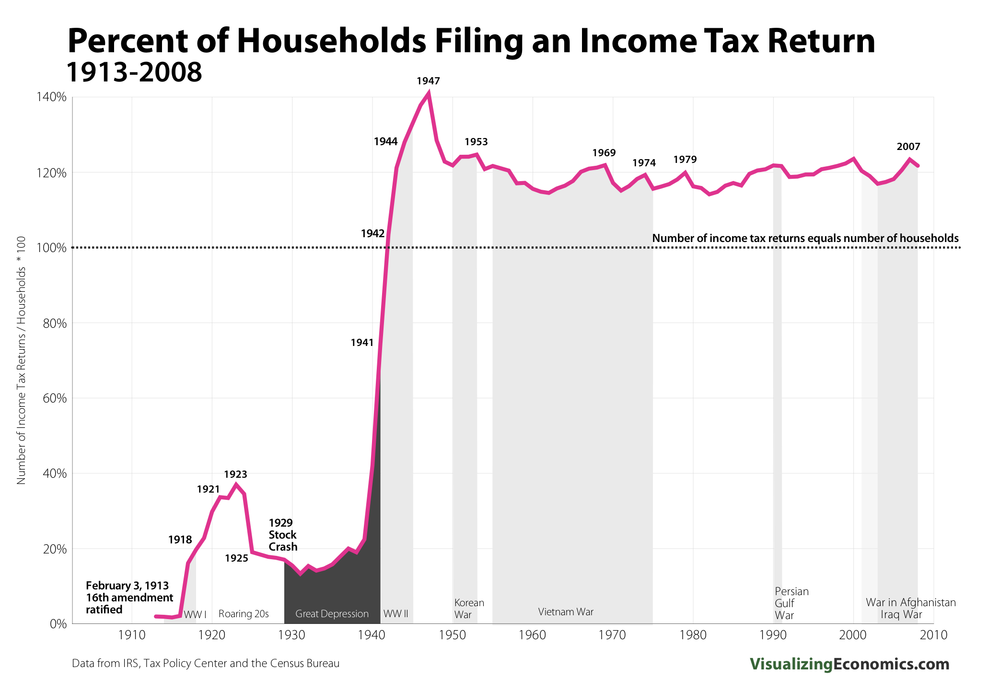
Piketty's first chart appears on this page, a chart showing income inequality in the United States from 1910-2010. I think it is relevant to match Piketty's data with the number of people who actually had to file. 


Clearly the early data is very sparse, in 1913 as low as 2% of households filed. Is it coincidental that the WW II era explosion of number of returns coincides with Piketty's chart  that features a remarkably sharp decline in inequality? Or has Piketty pushed his chart beyond the reasonable limits of available data? 

I don't have any particular insight into the sparseness of data for Piketty's second chart but the first chart tells me that somebody should check the numbers and ask the relevant question, whether the early portion of the data is as questionable as his first chart looks to my eyes. Piketty himself notes that his data is not as widespread as he would like it to be. It would have been responsible to add a line between the years of robust data availability and the zones where caution is warranted. It is a responsibility that Piketty seems uninterested in meeting. Perhaps such things will be added in a 2nd edition. 

On page 27, Piketty errs when he says "the fundamental R > G inequality, the main force of divergence in my theory, has nothing to do with any market imperfection." There is a market imperfection. It is real. By saying that there is no market imperfection, Piketty is implicitly excluding the laboring class from joining the investor class and making an artificial barrier into a natural barrier. The laborer shall be the laborer and never a capitalist. The world does not work this way. 

Piketty has to explain Andrew Carnegie, who started as a telegrapher and became one of his age's foremost capitalists as well as all the other famous and not so famous self-made men who have made the transition. From all I have read, he never addresses this change of role potential. 

Piketty claims that the rapid growth of population in the US from 3M at the time of the Declaration of Independence, and the rapid growth of territory from the 13 colonies to the addition of Alaska and Hawaii in the 1950s make the US experience a non-generalizable outlier and that the correct model to look at the general world case is slow to expand France which only doubled its population during the same time period. The territory changes of France with the addition and subtraction of its colonial possessions is tastefully left out of the discussion. It likely would only confuse the narrative. 

Of course by a priori excluding the US example as a model going forward, Piketty is cheating. He does not bother to prove his justification for excluding the US. It's just declare it as a non-generalizable outlier and move on. 

I do agree with Piketty on the importance of gathering data and using the real world to inform and judge theories. A pretty theory that doesn't work and thus should be jettisoned is a global attitude that would have saved us from the gulag and would resolve the present problems of both North Korea and Cuba. But Piketty is only imperfectly applying his own standards here. He should be held strictly to them. For instance, he declares that the changes in US territory and demography lead it to be "no longer the same country". So how many countries is it and what is the data for each of those virtual countries? There is no data presented. 

Does R > G indicate a shortage of capital or a surplus of capital? It would seem obvious to me that this status indicates a shortage, but the cure that Piketty prescribes would indicate that he believes that it indicates a surplus. You raise taxes on what you want less of. Perhaps I simply misunderstand and R > G can happen whether capital is in surplus or shortage, ie there is no relationship. I do not see how that can be true but I'm willing to be persuaded if Piketty ever gets around to addressing a small matter such as this. 

This concludes my examination of Piketty's Introduction to Capital in the Twenty-First Century. I picked up the project because I had a surplus of time on my hands as I was waiting for some very long database reindexes. If this occurs again, I may pick up the book and proceed further but for now this will be the end of this series. 

Sunday, June 8, 2014

Piketty's Introduction - Part III

This is a four part series going through Thomas Piketty's Capital in the 21st Century the parts can be found here:
Part I, Part II, Part III, Part IV

After only suspecting it from press accounts, picking up Piketty's Capital in the Twenty-First Century has convinced me by the second paragraph of its introduction that it desperately needs a thorough fisking. I'm picking up here from page 15 on the introduction.

On page 15 there's an interesting concept introduced of "inequalities at the global level" that leaves me scratching my head. China "may well prove to be a potent force for reducing inequalities on the global level" but isn't China's turning towards capitalism mean that its headed towards more inequality? What is different (superior?) about the Chinese road towards the market? Before Deng, what was China's role regarding inequality on a global level? I would hope that Piketty explores this more fully later. We'll see.

The idea that you can make any sort of straight line trends in global economics last 35 years, much less 85 years with a straight face is in my mind, well, naive at best. But Piketty goes for it even as he makes sure to inject enough uncertainty in his projections to make this statement meaningful. In other words, he's dog whistling about the world ending up being owned due to the straight line projection across several decades. If anybody of influence were to call him on this, no doubt he would retreat, and quickly. From the media appearances I've observed, he's obviously not enough of an idiot to defend such a declaration, though he is enough of one to have made it in the first place.

An interesting assumption embedded in Piketty's snark about Solow and Kuznets "balanced growth path" is that the rich world is advanced in the sense that Solow and Kuznets meant. That's not actually proven. For instance in the 1970s, the US made a retrograde move that established an oligarchy in bond rating agencies, one that continues to this day. How many other retrograde moves have been made and what does that mean in the sense of the Kuznets curve? There's plenty of pages to go and perhaps Piketty addresses this later but it is as absurd to assume that capitalism is a one way road. As Newsweek famously observed in 2009 "we are all socialists now." Has this socialism turned back the clock on the Kuznets curve? Is that even on Piketty's radar?

The 19th century economists, especially Marx, underestimated the mobility of people to change roles when the legal system permits them to and the economic system incentivises them to. Our economy would be more balanced if we made these role transitions easier. In reality the forces influencing these role transitions are decidedly mixed with considerable government pressure making them harder. We have, just to take one example, qualified investor rules limiting certain investment opportunities only to the well off that are completely out of place in a world that has undergone an information revolution.

There's a four page run where Piketty is acknowledging his colleagues and making a few technical points. Nothing to complain about there, and thank goodness for pacing issues in this analysis.

But page 20 has a bit of interesting caution to not accept any economic determinism, walking back Piketty's page 15 straight line analysis about who will own the world in 2050 or 2100. Piketty anticipates critics and refutes himself.

Piketty asserts that "there is no natural, spontaneous process to prevent destabilizing, inegalitarian forces from prevailing permanently." This is wrong as there is a powerful one, human nature. Those who are rich tend towards complacency and those who are poor tend towards activity. You have to work hard to beat the poor down into giving up, especially in a world of cheap information and huge gaping holes of unfulfilled goods and services. As this is a major result of the study that the book is based on, Piketty is in trouble long before he pulls out his first spreadsheet because, like Marx, he doesn't get people right. Let us hope it is with less momentous consequences.

It is really breathtaking, Piketty's idea that the market has little to do with the catch up in economies that are happening in a number of formerly poor economies. A key portion of the "process of the diffusion and sharing of knowledge" that is driving that catch up is that markets work and it is wise to dismantle the legal structures that prohibited or restricted markets in these countries. But for Piketty, that sort of knowledge diffusion is a priori not important.

In the forces of convergence section, there is a great elephant of a void, one that is quite noticeable if you don't have Piketty's sort of ideological blinders on. Over time, if you are prudent, you can move from being a laborer to a capitalist, and it would be normal that there are a large number of people who gain income from doing both and shifting emphasis from one to another as a counterbalancing force, chasing the better deal.

If capitalist activities are where the money is, there would be a natural tendency to increase effort in those areas and to divert income to investments, bidding up the prices and thus reducing the returns on capital. The sort of world where there's a tiny class of investors and everybody else gets all their income from labor is simply not today's world. This is exactly the sort of evolution that supports the Kuznets curve. That we're presently sabotaging this evolution via a huge creation of moral hazard by central banks and other policy stupidities does not change the underlying reality that humans tend to follow the money when it comes to earning their daily bread and Piketty's book is largely devoted to the proposition that they do not.

If you give short shrift to and do not accurately list the forces for convergence, of course they will look weak and easily overcome by forces for divergence. Again, this is an argument that does not depend on Piketty's statistics being in error, though the argument would be consistent with the errors that the FT found in its analysis.

Once again, I have reached the point where it is too long to go much further on a blog post and will try to pick things up again later.


Saturday, June 7, 2014

Piketty's Introduction - Part II

This is a four part series going through Thomas Piketty's Capital in the 21st Century the parts can be found here:
Part I, Part II, Part III, Part IV

After only suspecting it from press accounts, picking up Piketty's Capital in the Twenty-First Century has convinced me by the second paragraph of its introduction that it desperately needs a thorough fisking. I'm picking up here from page 7 on the introduction.

Wages are not hard linked to economic growth in capitalism. Wages are an epiphenomenon of the supply and demand of labor. With the countryside emptying out in a rush during the early industrial revolution, capital and labor became strongly unbalanced. The reasons for this were good. Increased yields from new technology led to less starvation and less need for farm labor. Unsurprisingly this led to low and stagnant wages at the urban receiving end until this huge wave of labor was absorbed and capital pools grew to a level that led to the bidding up of wages as capitalists had to start to compete for workers in a more serious way. Nobody who has gotten past undergraduate economics should be surprised, yet Professor Piketty seems surprised writing about the period "[t]his long period of wage stagnation, which we observe in Britain as well as France, stands out all the more because economic growth was accelerating in this period." This seems to be coming from a milieu of social justice and not economics. That would be fine if this were not an economics book. Or is it?

On page 9, Piketty passes over one of the greatest failures of Marx, the pretense that his vision of communism was scientific. A scientific communism is a communism that runs an experiment and when the experiment fails, it stops. Marxism never stops. It just gets new excuses.

It's only page 10 and Piketty seems to be undermining one of his previous statements that inequality inevitably leads to violence with the observation that inequality still was increasing in WW I but since wages were catching up, the spectre of proletarian revolution was receding in the advanced industrialized world. Is this what he means by "modern" economic growth? There's nothing particularly modern about absorbing and correcting a surplus of labor with the creation of new enterprises to occupy them.

Piketty is once again unduly kind to Marx by excusing his failure on a lack of statistical information. "If only the [great man] had known" is the cry of suckers who believe in failed systems and Piketty is engaging in that a bit here. It is particularly relevant to note that Marx's labor theory of value does not work. Marx raised important questions. So can a five year old. Such an act, unaccompanied by correct answers is not the stuff of greatness. Here Marx, have a cookie for asking an interesting question. Now go stand in the corner of historical villainy for making the gulag possible. Piketty has lousy taste.

Accumulated wealth is ultimately of two sources, gathered and/or maintained by violence or gathered/maintained by skill. The former is to be condemned and fought against. The latter is intergenerationally unreliable (ie over the scale of time that generates social instability). Societal measures should target only the first. Piketty's preferred solution to the problem targets both. People do not go out into the streets to fight against Bill Gates riches in relevant numbers because manifestly he is doing a world of good, as do many of his peers. The Democrat party's obsession with the Koch brothers is relevant here. Explaining both why the Democrats have made them their great white whale and why ultimately it's not giving them the political traction they hoped.

Piketty is in love with statistics and so I see why he might think that income tax is "useful for establishing classifications and promoting knowledge as well as democratic transparency" in his discussion on Kuznets. The usefulness of this information is a bit counterbalanced by the enabling effect on envy and the almost inevitable reduction of societal solidarity. Pity he doesn't mention those effects. They must not fit his narrative. In a book devoted to the ill effects of inequality, it's a little surprising that he's overlooking this contribution to those ill effects.

Kuznets, with his eponymous curve, seems to be the big elephant that Piketty is aiming at. He calls it "magical", a term not usually professionally complimentary. Kuznets must be discredited for Piketty's thesis of dangerously growing inequality to have a chance. The Kuznets curve was "a product of the Cold War" which implies but does not say that it is wrong. The moon landing was a product of the Cold War. Does Piketty cast doubt on that because of its provenance too? Let's try it on for size, the "magical Kuznets curve" matched by the magical moon landing? I think not.

The Kuznets curve will stand or fall as we end up in a sufficiently long period without huge exogenous shocks that mask the effect if it's present. Piketty's snark doesn't move the conversation along.

Once again this is getting too long for a blog post. If I keep up this pace of analysis, I will be posting another 81 posts on this book. I may have to take lessons from Stephen Green towards the end. I don't think I'm going to make it in six more days. As annoying as finding these problems in Piketty's work, the thing is intellectually stimulating, probably in ways that Piketty didn't intend. For instance, it seems like under Piketty's analysis of global inequality, communism was anti-egalitarian. Now that would be an interesting interview question for Piketty but unlikely one that he would face.

Friday, June 6, 2014

Piketty's Introduction - Part I

This is a four part series going through Thomas Piketty's Capital in the 21st Century the parts can be found here:
Part I, Part II, Part III, Part IV

Piketty's introduction is the first problem with the book. He manages to get through paragraph one without serious problems but can't manage to extend that record to paragraph two.

Piketty claims
Modern economic growth and the diffusion of knowledge have made it possible to avoid the Marxist apocalypse but have not modified the deep structures of capital and inequality. 
But that's just not right. What is it about modern economic growth that makes it Marx bane as opposed to pre-modern economic growth? Piketty doesn't say up front. Perhaps later, but there doesn't seem to be much discussion of it uncovered by a Google search. The concept of a magical 'modern' economic growth doesn't make much sense. The diffusion of knowledge makes a very vague reference to the real issue of R > G but not in a particularly helpful way. Isn't the very existence of deep structures of capital and inequality the question that Piketty is putatively seeking to answer, ie whether Marx was right all along?

It's only the introduction but it's not looking good so far. Piketty has already revealed that he is assuming his conclusions.

It gets worse
When the rate of return on capital exceeds the rate of growth of output and income... capitalism automatically generates arbitrary and unsustainable inequalities that radically undermine the meritocratic values on which democratic societies are based. 
This is simply not true. You have to have an additional factor for an undermining effect to take place. You have to limit the conversion of individuals who live via labor to individuals who earn a living via capital. There are plenty of people who work to pull up the ladder that enables this conversion but they do not generally reside among the advocates of laissez faire. Piketty's advertised solution, a heavy wealth tax, pulls up the ladder quite effectively. This makes Piketty a decided villain by his own R > G standards.

An illustration should suffice. Take a room full of poor entrepreneurs. Add exactly one money bags investor. The economy will rely on the investor to supply virtually all the capital. Assume that out of 100 business proposals he funds 10 and being the only game in town he does so at quite advantageous terms to himself. 1 is a 100x investment success, 6 are variously successful averaging 4x return, and 3 go bust. The return to capital is clearly going to be greater than economic growth in this situation. But the 100x successful business yields enough money in the heretofore poor entrepreneurs hands that he can fund a venture all by himself and the 6 entrepreneurs can fund another 2 if they act together. The next funding round sees essentially 4 money bags and more businesses being funded. Each subsequent round will see less and less lopsided terms being granted the entrepreneurs. After all, they can play one investor off against another. More and more of the poor entrepreneurs will either propose or be part of a successful team. More and more deals will be self-financed. Eventually you get to a balance. This is the deep structure of capitalism and it is very different from what Piketty is assuming.

Now add Piketty's famous wealth tax and what happens. The money bags won't be investing in 10 businesses, but 7, the balance of his funds being absorbed by tax shelters and lobbying for loopholes in the wealth tax (which empirical observation leads us to guess that he will get but that it absorbs a large amount of time, effort, and money). The 100x entrepreneur winner in the first round might still be comfortable but likely not enough to fund the same sort of venture as before and the medium sized winners are fewer and even less capable of enlarging the pool of investors and increasing the fairness of terms in the next round of investment in business.

Piketty is trying to claim a moral high ground as early as page 1 but unfortunately for him, he is a policy villain. He seems to ignore that R > G is a price signal. This price signal is an encouragement to enter the field of capitalist and invest. Taxing the wealthy is a strong signal not to invest too much, diverting resources.

Piketty claims that "violent political conflict" is something that "inequality inevitably instigates". I look forward to seeing the data that proves this claim because I do not believe it to be true. Comfortable members of the middle class are not going to be going out into the streets because the rich are getting more comfortable faster. They are especially not going to be doing it when the path to their own riches clearly remains open if they wish to exert themselves. Inequality, per se, does not lead to violence. Additional factors have to be present.

I'll leave a placeholder here regarding Piketty's discussion on oil prices and urban land as he explicitly says that he'll provide a nuanced discussion later. Suffice to say his introductory remarks do not instill confidence. That the Chinese have (wisely or foolishly) built many empty cities demonstrates that increasing the supply of urban land is not that difficult. As for oil, there is a ceiling price to oil, and it's dropping. Fischer Tropsch plants can convert other hydrocarbons to liquid fuels. So long as the extensive investment costs can be recovered, a persistent level of high oil prices is simply not going to happen and that is putting aside the more exotic substitute goods of electric and fuel cell powered vehicles.

We are barely into page 7 of a 35 page introduction and this is already getting long for a blog post so I will stop here and add a 'part I' to my title.

Update: Piketty partially addresses the issue of substitute goods in footnote 3. I say partially because he claims that finding these substitute goods "can take decades to accomplish" which is weasel wording at best. Modern economies research pieces of substitute goods, often decades before they are generally needed and leave the results in patent offices and scientific journal, dormant until we approach the conditions where they become practical whereupon the vision of riches leads to their resurrection more often than not. Large price swings actually create a positive influence in this process as can be seen in the fits and starts refinement process that has made Fischer Tropsch a practical substitute good for drilling oil. At this point, it is only the long lead times for recouping investment and the uncertainty of how quickly other substitute goods for transportation fuel will emerge that are holding back this technology.

it's become clear to me that footnotes are where Piketty is going to be burying the inconvenient facts he must cover to save his reputation while minimizing the number of people who actually walk away with an appreciation of those facts. This is not quite an approach that is devoted to the honest search for truth.

Monday, May 12, 2014

I need a license for what?

The Town of Munster in Lake county, Indiana has a bit of a training issue on how they handle their solicitation licensing. I had heard that there was a local anti-solicitation ordinance and was driving by town hall anyway so I stopped by to figure out what was going on. The ordinance itself is pretty unobjectionable. In Munster if you're going to be asking for money, you need to get a background check and let the town know what you're doing and you're limited to going to the front door. You're not allowed to go wandering around private property.

I was directed to an office and asked if starting conversations and talking to people door to door would need notice and was informed that not only that it needed notice but that I needed to pay a fee as well. The explanation was vague and unsatisfying but they were at least savvy enough to suggest I look up the law on the town website as I had 1st amendment concerns. I stopped off at the police department and they called what I was doing a gray area and that in case of complaints (which they apparently get every day), I would get a warning to stop and then a citation for a few hundred dollars.

In the end, reading the ordinance made it clear that there was no need to apply for one. The town fathers hadn't flipped their lids and violated the Constitution. The higher ups knew what they were doing. They just aren't training their front line people to be clear about what's going on and their printed materials lack the text of the law so you have to do just a bit of digging. I wonder how many people just forked over the license fee?