Words have meaning. It seems perfectly obvious to me that the Caliph leads the Caliphate and that the caliphate is the multi-national collection of islamic states. In general terms, the Caliph is an emperor, which makes restoring the caliphate an imperial project, and radical islam, which wants to restore the caliphate, an imperialist venture.
Then the world turns upside down.
The putatively anti-imperialist forces in the west on the left tend to be the softest when it comes to radical islam. Bill Maher has made left wing softness on radical islam a major theme of his career. But even Maher doesn't look at radical islam in terms of empire. For him, his opposition is part and parcel of his deep commitment to atheism. To him radical Islam is just religion on steroids.
Finding anti-imperial critiques of radical islam arising from the left is tough going. This provides an opportunity to call out the left and for a new left to arise that is authentically anti-imperialist no matter where imperialism arises.
Showing posts with label religion. Show all posts
Showing posts with label religion. Show all posts
Monday, January 19, 2015

Wednesday, January 7, 2015
Je Suis Charlie
Islamic radicals, with their usual style, have asked the world to repeat Everybody Draw Mohammad Day. As before this has caught me by surprise so I will simply repeat my earlier entry.
This sort of image of Mohammed, illustrated by muslims, is just as blasphemous to the iconoclastic primitives who just murdered a dozen french satirists in Paris as any of the other cartoons and drawings floating around. I picked it because we should not forget that these barbarians want to murder Islam's past as much as our present.
#IAmCharlie
Is it draw Mo day already?
Here's something from the Mohammed Image Archive, a reproduction of Islamic art.
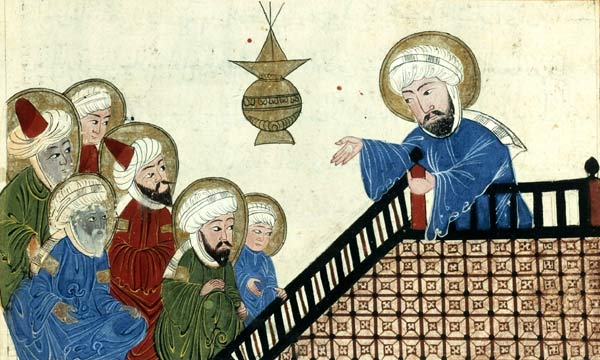
Ok, I'm ready for my fatwa now.
This sort of image of Mohammed, illustrated by muslims, is just as blasphemous to the iconoclastic primitives who just murdered a dozen french satirists in Paris as any of the other cartoons and drawings floating around. I picked it because we should not forget that these barbarians want to murder Islam's past as much as our present.
#IAmCharlie
Thursday, September 11, 2014
9/11 is not for muslim whining
A 9/11 muslim whine fest offended me today. It seems that Islam has an image problem in the US. Boo hoo. Today was not the day to publish that. It's tone deaf and likely to make american opinion of muslims worse. It's sort of a japanese journalist like picking December 7th to discuss anti-japanese sentiment, a problem that's only ever potentially there because the japanese are generally not dumb enough to do such a thing.

In any case, if you want to measure hate over time, you're best bet isn't surveys but crime reports. Anti-religious hate crimes have been broken out and reported for years and we have good data for 1996-2012. Here are the trend lines for all the sub-groups.
Hate is up for catholic, atheist, and multi-religious categories. Everybody else is flat to down. As always, anti-jewish hate crimes predominate the numbers but they've got the best trend line of the bunch so maybe in a few decades the jews won't be number one anymore. I'm sure they're looking forward to it.
The muslim trend line is generally flat except for a 9/11 related, one year bump (481 incidents). Most of that went away but the baseline moved up from around 30 incidents a year to perhaps 140 give or take with arguably a slight down trend between 2002 and 2012. This is not the picture of growing anti-muslim persecution the article hints at with its talk of a recent bias crime spike.
9/11 is not the time for a story hook of anti-muslim bias that isn't even accurate.
Sunday, April 20, 2014
Christ is Risen
For the Easter season, romanians say to each other in greeting "Christ is risen" and respond "Truly He is risen". It's an eastern tradition that runs across many churches.
So to all of you, friends, and future friends, acquaintances, and enemies I hope to make peace with, to everybody reading I say to you Christ is risen and wish you all the good things that are promised with that statement.
Wednesday, April 16, 2014
Catholic Death Penalty
The argument in the Catholic Church regarding the death penalty has always proceeded on terms that are not that clear to many outsiders. The essence of the argument for invalidating the traditional permission for the death penalty is that something fundamental has changed about modern penal systems, that for the first time ever we can prevent crime and that it is safe to keep heinous criminals alive and thus the death penalty should be abolished.
The counter in Catholic circles has always been that it is simply not true, that nothing fundamental has changed. It has always bothered me that neither side seems eager to tear the covers off what modern prisons are really like and honestly, openly monitor matters. Here's a data point on the pro-death penalty side. Murder spree conducted by sex offenders wearing GPS ankle bracelets.
Can we trust the state to actually keep us safe? That's an open question.
Tuesday, March 18, 2014
What muslim moderation looks like
Takfirism, the eager use of apostasy charges to violently repress muslim diversity and kill anyone who is not sufficiently orthodox in the eyes of the accuser, is a major threat to everyone who is not part of the Takfiri in group. The violent muslims who threaten america are overwhelmingly Takfiri.
Commenting on a pretty good Emirati newspaper opinion piece, Akhram's Razor puts the blame on the toxic brew of massive Saudi oil money fueling Wahhabism. As he puts it:
Commenting on a pretty good Emirati newspaper opinion piece, Akhram's Razor puts the blame on the toxic brew of massive Saudi oil money fueling Wahhabism. As he puts it:
When you view the world through the Manichiestic, inherently intolerant lens of Wahhabism and its various offshoots, Takfirism makes sense. In that context, any moderation is necessarily tactical as opposed to principled since the underlying worldview leaves no room for compromise. And no amount of political pressure will change that instinctive posture towards the world (including other Muslims).Strong stuff, and what a lot of us have been looking for from muslims all along. We don't know, and will never know, Islam like believers do. We depend on the moderates who declare themselves on our side to make sense of it all if we're not going to descend into a wider use of violence than is absolutely necessary. One of the nice collateral benefits of moving off of oil is the reduction of the outsized influence of Saudi Arabia:
As I’ve said before, the Muslim world (and even Saudis) will be much better off when those accursed wells finally run dry and the Khaleej returns to fishing and animal husbandry.Both are just a matter of time, I think. The question is how much more harm they will cause us all in the meantime, as they make their cosmetic reforms (to much fanfare) to this monstrous counterfeit orthodoxy that they pumped into the Ummah’s bloodstream for decades. And, meanwhile, many leaders rest of the Muslim world politely change the subject, either out of a disastrously misplaced sense of decorum or adab, or simply fear of loosing a place at the petrodollar feeding trough.This is why I keep Akhram's Razor in my mix of blogs to read even though we don't see eye to eye on a lot of issues.
Monday, March 17, 2014
Papist GOP
This Pope seems to be having a pretty good bit of influence on the GOP lately. Despite some early worries that he might be hitting a marxist line, that seems to have died out for the most part and Pope Francis' call to be involved in solving the problems of poverty by more than just an impersonal check seems to be bearing fruit in the GOP.
How many divisions does the Pope have? It looks like he might have a few in the GOP. Who knew?
How many divisions does the Pope have? It looks like he might have a few in the GOP. Who knew?
Saturday, March 15, 2014
The Pope comes to Congress?
Speaker Boehner has invited his Holiness Pope Francis to address a joint session of Congress. I think that Francis' influence on GOP politicians, especially Paul Ryan is significantly underestimated. I think the GOP is responding to Pope Francis' call to keep the poor in mind and while they aren't changing their minds, they are paying more attention with authentically conservative policy to help the poor.
I hope the Pope does come. It might be educational all around.
I hope the Pope does come. It might be educational all around.
Thursday, March 13, 2014
Cosmos Reboot Review
I dug up Cosmos on Hulu and just finished watching it with my younger daughter. The Bruno section was as bad as the write up in Slate advertised it to be but there was a great deal that was quite right and promoted science very well.
Tyson's promo interview describing science on Colbert was subtly wrong but he got it right in the show itself which was a relief. There were a few things that were overly speculative, the multiverse section sticking out the most for me so a bucket list of mistakes is probably worth reviewing. I hope they settle down and stick to the science.
Tyson's promo interview describing science on Colbert was subtly wrong but he got it right in the show itself which was a relief. There were a few things that were overly speculative, the multiverse section sticking out the most for me so a bucket list of mistakes is probably worth reviewing. I hope they settle down and stick to the science.
Wednesday, March 12, 2014
Orthodoxy is moving
For 1200 years the Orthodox have not held an ecumenical council. They will hold one in 2016. The ground is shifting, change is coming and nobody knows how it will play out.
Science: Right or Wrong
Does science prove theories or laws correct? Or does science simply say that a theory hasn't yet been proven wrong? These sound like very esoteric questions but it's the difference between scientism and science, respectively.
Science attempts to guess at the laws of the universe, computes the implications and consequences of the guess and compares them to experience or experiment. If they don't match, the theory is wrong. If further experiment reveals gaps, the theory is incomplete and thus wrong. Incomplete theories can still be useful. We use newtonian style calculations to this day even though we know that those theories are wrong. They are close enough to reality for a wide range of use cases that they still work, just as long as the limits to their usefulness are kept in mind.
Science is utterly useless as a religious system. For that scientism is a far superior option but scientism has no credibility and no usefulness except when it camouflages itself as science. Scientism says stop thinking, stop examining, stop studying settled issues. They are the corpus of established science, the bible which should not be questioned. When preachers rail against science, it is this that they are protesting by and large. But scientists should be just as dubious about scientism as the preachers. Scientism is not science. It is a kind of philosophical cuckoo's egg, a fraud pretending to be science and bringing actual science into disrepute, causing confusion as to what science actually is.
Tuesday, February 25, 2014
Economic Exclusion
I personally use Mark Shea as a way to make sure I don't slip into a cognitive bubble. I'm sure he'd be delighted to know that he's often an intellectually uncomfortable read. Even stuff I already know about, like the continuity between Benedict and Francis on economics can lead to new sources and new challenges that keep me from going intellectually stale. Today's burr under my saddle is Ethika Politika where I find ‘Where is Unfettered Capitalism?’ and Other Questions on Evangelii Gaudium.
The problem is paragraph 53 of Evangelii Gaudium which talks about the excluded as different from the marginalized or disenfranchised. It's a paragraph that I scanned while hurrying to read the whole thing and figure out what the fuss is all about and, frankly, didn't give sufficient attention to at the time. It's not a concept that makes much sense from a free market perspective.
The category of excluded would imply excluders (who must be distinguishable from marginalizers). Who are they? Who is taking time to entirely exclude people from society? Who is devoting resources to the task? What are they doing? Is what they are doing properly characterized as market action or something else?
I've tried to chase this rabbit to the back of the warren before. I've never come up with an actual instance where excluders were not either:
1. inchoate, not really existing boogeymen
2. people taking non-market actions that were wrongly defined as market actions.
Ultimately, without real world exclusion actually happening, what the pope is talking about is theoretical nonsense. finding those real world examples would be very helpful in getting a pretty big segment of American conservatism on side with the Pope. I don't see much activity along those lines.
Marginalization is a failure of imagination, mostly of figuring out how to include a person with unconventional and perhaps limited possibilities but also of empathy that some accident or disease may put us in the place of those who cannot earn their daily bread. Exclusion is the positive expense of effort and resources to place a barrier keeping others out. Who actually does that as a market action? The market may tolerate it as one more irrational non-market impulse but it does tend to punish such things.
Thursday, December 19, 2013
NSFW Duck Dynasty
GQ has turned into a profane magazine. I haven't read it in years and never thought it pulled many punches but whatever language restraint it might have had is gone. You can't talk about the current Duck Dynasty controversy that has led to the indefinite suspension of Phil Robertson (the family patriarch) honestly without some adult conversation so if you haven't had the birds and bees talk yet, pass this one by kids. There's a chunk of ick and ewww that follows.
In order, there are three mentions of homosexuality in the GQ story about Phil Robertson. These are the things for which he's been put on indefinite hiatus. Here they are in their entirety interspersed with a bit of commentary from me. The italics are an interviewer question included for context.
That sad reality is a travesty.
In order, there are three mentions of homosexuality in the GQ story about Phil Robertson. These are the things for which he's been put on indefinite hiatus. Here they are in their entirety interspersed with a bit of commentary from me. The italics are an interviewer question included for context.
It seems like, to me, a vagina—as a man—would be more desirable than a man’s anus. That’s just me. I’m just thinking: There’s more there! She’s got more to offer. I mean, come on, dudes! You know what I’m saying? But hey, sin: It’s not logical, my man. It’s just not logical.This isn't even biblical for the most part. It's sex talk and describing sex preference. "That's just me" is not something that intolerant regularly say, but rather the tolerant who march to their own drummer and have their own opinions. When did that become a problem in the US?
What, in your mind, is sinful?
“Start with homosexual behavior and just morph out from there. Bestiality, sleeping around with this woman and that woman and that woman and those men,” he says. Then he paraphrases Corinthians: “Don’t be deceived. Neither the adulterers, the idolaters, the male prostitutes, the homosexual offenders, the greedy, the drunkards, the slanderers, the swindlers—they won’t inherit the kingdom of God. Don’t deceive yourself. It’s not right.”Let's see, about 98% of the people that are in those groups are not homosexual. Who's protesting? The homosexuals. And let's see what this holy roller is threatening all these people, that the afterlife won't be kind to them, when Jesus comes back on Earth, they will not inherit the kingdom of God. Oversensitive much?
We never, ever judge someone on who’s going to heaven, hell. That’s the Almighty’s job. We just love ’em, give ’em the good news about Jesus—whether they’re homosexuals, drunks, terrorists. We let God sort ’em out later, you see what I’m saying?News flash, this is the true takeaway. Phil Robertson loves gays, every one of them. He doesn't judge them as unworthy of heaven, leaving that up to God. He wants them to be happy and be saved. This is unacceptable conduct in today's America.
That sad reality is a travesty.
Thursday, December 5, 2013
Christian Democracy foulup
Christian Democracy is a monthly e-magazine that regularly raises my blood pressure. They are reflexively anti-libertarian and free market. This month they're mocking the Acton Institute and an article from their head researcher responding to Pope Francis' apostolic exhortation Evangelii Gaudium.
Originally I was going to do a long comment there but I went beyond the limits of their commenting system so decided to turn it into a post. If you don't read the article, you might want to pass on the response below.
Originally I was going to do a long comment there but I went beyond the limits of their commenting system so decided to turn it into a post. If you don't read the article, you might want to pass on the response below.
This article goes downhill from about the second sentence. It assumes an opposition without demonstrating it. Fr. Sirico himself has addressed Evangelii Gaudium in a video that came to me via youtube. It can be found here.
The response is not "inevitably" anything of the sort.
Venezuela sends the army into the biggest national chain's electronic stores and forces prices downwards at the point of a gun. This is not hyperbole, but the reality of mid November
http://www.theguardian.com/world/2013/nov/15/venezuela-army-occupy-shops-profiteering
This sort of redistribution just guarantees that once the goods are gone nobody will volunteer to lose money buying more and the familiar socialist spectacle of near empty shops will happen one more time. So what forms of redistribution is Pope Francis talking about? What form of redistribution is Samuel Gregg worried about? I'm not convinced that they're on the same page, talking about the same sorts of redistribution.
There are plenty of changes in economic regulation that would help the poor economically that would be perfectly fine with the Acton Institute. I have a feeling that Pope Francis would be happy if these changes would be made too. Reductions in licensing laws that permitted more new company formation and small enterprises done by the poor are not, I think, a matter of disagreement.
But this would not be an increase in economic regulation but a decrease in regulation that hurts the poor. One of the things that my own private interpretation of Francis is detecting is unhappiness with the tilted playing field of capitalists renting government for their private benefit and to the detriment of the poor. Rules that insufficiently take into account adverse possession, impoverish the commons, and unnecessarily make it expensive for the poor to protect their own goods and to access justice are real issues.
These forms of economic playing field rigging have never been part of the official capitalist playbook but they show up often enough in real life that it is a real problem for capitalism as it is actually lived in the world.
This playing field rigging has led to lower and lower rates of company formation as incumbents continually work to rid themselves of the plague of economic insurgents trying to compete with them which both restricts the supply of C level management (and thus raising their compensation) and reduces the supply of jobs, lowering the demand for labor and thus wages.
There is no theoretical difficulty for capitalists. There has always been lip service paid to these issues. The real world where regulations are written and legislation to un tilt the playing field is proposed tells something of a different story. The anti-rigging coalition is very often a minority one. I think that this lack of success at running an honest in reality capitalism as opposed to an honest in theory capitalism is what Pope Francis is aiming at. He is not issuing a theoretical challenge to capitalism but a practical one of ensuring that practice matches theory in a way that is a preferential option for the poor.
The downward pressure on wages is not an immutable feature of capitalism. It is an artifact of the fact that we still do not live in a capitalist world and there is always another supply of subsistence farmers out there that will happily get out of rural poverty to take a crack at the utterly miserable but better than their past sweatshop factory jobs. But this is a mode of economic activity that is entering its end game because India and China are undergoing wage inflation and we shall not see a like flood of new workers onto world markets again. But the cure for this labor supply problem is more capitalism, more company formation, more labor demand to bid up wages.
I disagree that the Pope is looking for structural reform as an end. He is looking for radical, personal involvement of love and solidarity to help solve the economic exclusion of the poor in a way that promotes dignity and justice. That's a major change but not one that is fundamentally a problem the legislature can address.
Wednesday, December 4, 2013
Totalitarian Capitalism
I've been pondering Pope Francis' recent writings and have come to certain conclusions about some serious miscommunication regarding what the Pope is doing. Contrary to a lot of the Francis miscommunication corpus, I don't think that this is the Pope's fault.
Capitalism is not, properly speaking, a totalitarian system. It requires a separate moral system, a guide to provide purpose to all the buying and selling. It can fit to a wide variety of moral systems which is a good reason that capitalism ends up being global.
Capitalism's limits to economic acts create a space for morality to survive and thrive and are natural fetters to the system. These are the fetters that would interest a churchman. Unfettered or unregulated capitalism is totalitarian. If you're worshipping mammon. If you find value only in your bank account, if there is no other system that informs your purchases and your production, then you have a serious problem. The fetters of government regulation in the economic sphere are irrelevant to Pope Francis because he's not a politician and not an economist. He has a different scope for his job and vocation.
This is a virtue problem and one that has real world, practical effects. The difference in the education levels in virtue in the American colonies at the start of its revolution and Bourbon France at the start of its revolution are a major factor in why the former succeeded and the latter was ultimately a failure that died in the terror.
Pope Francis' gig is ultimately to inculcate virtue and prepare us for Heaven. Occasionally this means he falls into the jargon of his profession which, like all professional jargon, is sometimes confusing because in different professions, the terms have different meanings.
cross post: Chicago Boyz
Sunday, December 1, 2013
Despoliation of the poor
Pope Francis' supposed anti-capitalism has been exaggerated but what is he going on about with this poor stuff? Perhaps, in part, it's something like this.
Hawaii's five-term state rep Tom Brower (D) finds carts that the homeless either find or take from stores and removes their belongings and breaks the carts with a sledge hammer. If it's convenient enough, he'll return a store's cart but most of the time he's just breaking stuff. These carts retail between $150-$200 and according to the video, he's destroyed about 30 of them, for a property destruction spree of $4500-$6000. I do not expect a prosecution any time soon.
This isn't compassion, love, or solidarity. Then again, it's not capitalism either. The store owners are the only capitalist players in this story. Apparently they have tolerated "shrinkage" in their cart stock and don't even file police reports when their carts go missing.
Rep. Brower is a funny sort of 21st century Javert but he retains all the charm of the original.
Thursday, November 28, 2013
Undoing statist distortions of Francis
The false idea of Pope Francis, anti-capitalist, has grown with the release of his apostolic exhortation Evangelii Gaudium. Part of the problem is that everybody's quoting Francis on his condemnation of a "theology of prosperity" or "culture of prosperity" but nobody is bothering to transmit his definition. For a pope, this is a term of art, a technical term that does not necessarily match up with what someone on the street might guess at its meaning. The definition is right there in the same document so if the journalist actually read the thing, there really is no excuse.
Pope Francis does not deal in specifics as to how the goods he recommends "dignified work, education and healthcare", be acquired or assured. In the US, for example, the government strictly limits the number of medical residency spots, residencies being mandatory for the practice of medicine in the US. Increase those spots or decrease the spots and you can crudely adjust the price of healthcare by adjusting the supply of doctors. Neither action has anything to do with the free market. It's an adjustment of a government allocation. If the allocation is broken, it's for the big government types to explain and justify. Similarly, there are pro-free market interpretations on improving dignified work and education. That doesn't mean that Francis is pro-capitalist. It just means that he's doing his job, leaving sufficient ambiguity that the laity so it members can legitimately take all reasonable sides in the debate while pointing to the theological and ethical goals that are appropriately Catholic.
In other parts of our society, we see the growing attraction to various forms of a “spirituality of well-being” divorced from any community life, or to a “theology of prosperity” detached from responsibility for our brothers and sisters, or to depersonalized experiences which are nothing more than a form of self-centredness.Once you plug in this definition, Francis' condemnation of prosperity takes on an entirely different character. That definition, by any stretch of the imagination, is not the "ethic and ideology that underlie free-market economies" except in the fever dreams of socialists eager to paint a false picture. This culture of prosperity is a permissible choice under the free market because, properly speaking, the free market is not totalitarian. It is neutral in areas that are not in its competence (economics).
Pope Francis does not deal in specifics as to how the goods he recommends "dignified work, education and healthcare", be acquired or assured. In the US, for example, the government strictly limits the number of medical residency spots, residencies being mandatory for the practice of medicine in the US. Increase those spots or decrease the spots and you can crudely adjust the price of healthcare by adjusting the supply of doctors. Neither action has anything to do with the free market. It's an adjustment of a government allocation. If the allocation is broken, it's for the big government types to explain and justify. Similarly, there are pro-free market interpretations on improving dignified work and education. That doesn't mean that Francis is pro-capitalist. It just means that he's doing his job, leaving sufficient ambiguity that the laity so it members can legitimately take all reasonable sides in the debate while pointing to the theological and ethical goals that are appropriately Catholic.
Subscribe to:
Posts (Atom)