Words have meaning. It seems perfectly obvious to me that the Caliph leads the Caliphate and that the caliphate is the multi-national collection of islamic states. In general terms, the Caliph is an emperor, which makes restoring the caliphate an imperial project, and radical islam, which wants to restore the caliphate, an imperialist venture.
Then the world turns upside down.
The putatively anti-imperialist forces in the west on the left tend to be the softest when it comes to radical islam. Bill Maher has made left wing softness on radical islam a major theme of his career. But even Maher doesn't look at radical islam in terms of empire. For him, his opposition is part and parcel of his deep commitment to atheism. To him radical Islam is just religion on steroids.
Finding anti-imperial critiques of radical islam arising from the left is tough going. This provides an opportunity to call out the left and for a new left to arise that is authentically anti-imperialist no matter where imperialism arises.
Showing posts with label civilization. Show all posts
Showing posts with label civilization. Show all posts
Monday, January 19, 2015

Sunday, January 11, 2015
Education
Is it just me or are people looking to expand the time spent on preparing for life while shrinking the time spent actually living life productively? Instead of proposing free community college, turning the secondary education system into grades K-14, wouldn't it make more sense to work to stuff more learning into the present time available?
The problem with my proposal is that we'd have to pay attention, seriously ask what is school for, and take action to fix what ails the education/employment system. There are entrenched interests standing in the way of that conversation and the likelihood of success is low. So why not just whistle past the graveyard as another year is lost by kids being taught inefficiently and ineffectively?
The problem with my proposal is that we'd have to pay attention, seriously ask what is school for, and take action to fix what ails the education/employment system. There are entrenched interests standing in the way of that conversation and the likelihood of success is low. So why not just whistle past the graveyard as another year is lost by kids being taught inefficiently and ineffectively?
Wednesday, January 7, 2015
Je Suis Charlie
Islamic radicals, with their usual style, have asked the world to repeat Everybody Draw Mohammad Day. As before this has caught me by surprise so I will simply repeat my earlier entry.
This sort of image of Mohammed, illustrated by muslims, is just as blasphemous to the iconoclastic primitives who just murdered a dozen french satirists in Paris as any of the other cartoons and drawings floating around. I picked it because we should not forget that these barbarians want to murder Islam's past as much as our present.
#IAmCharlie
Is it draw Mo day already?
Here's something from the Mohammed Image Archive, a reproduction of Islamic art.

Ok, I'm ready for my fatwa now.

This sort of image of Mohammed, illustrated by muslims, is just as blasphemous to the iconoclastic primitives who just murdered a dozen french satirists in Paris as any of the other cartoons and drawings floating around. I picked it because we should not forget that these barbarians want to murder Islam's past as much as our present.
#IAmCharlie
Sunday, September 28, 2014
In favor of a sustainable living wage
Right now we're living through a time of massive imbalance in the global labor market. The number of people who are available for work outsourced from around the globe has exploded and continues to grow larger. This is happening because poor economic policies are in retreat in the developing world and pro-globalization policy adoption remains high, continually feeding more and more people from India, China, and smaller developing nations into the global labor market as they walk down the path of converting their farmer/peasant heavy populations to first world levels. This massive imbalance has created a market signal reducing salaries below living wage levels at the bottom end of the labor market. Until that signal resolves in increased demand for labor, it leaves more people stuck in dead-end rural situations, urban workforces constantly in emergency mode, trying to scrape by, and lower standards of living for virtually everybody who is a worker all over the world.
There is a way to create a living wage consistent with free market principles. I call it the sustainable living wage. It's based on the idea that increasing the demand for labor and reducing the supply of labor both cause a natural rise in wages that need not be artificially mandated by legislation, and is not subject to evasion by paying people a lower wage "under the table". In a sustainable living wage environment, workers have better things to do than play black market games with skinflint employers. Down the road, somebody else is paying better.
A living wage based on forcing, by law, employers to raise wages beyond the market clearing price will, over time, always lead to substituting capital for labor and other methods of getting around the law such as falsely reporting working time and hiring "under the table". It also promotes acceptance of inflation in the employing class as that erodes the economic penalty of minimum wages. Inflation is probably the worst economic blow that an otherwise normal government can strike against the poor while calculating that it won't get called out for it.
A sustainable living wage, in order to be sustainable, must not create these perverse labor substitution incentives for employers which is what too often happens with traditional efforts to raise a minimum wage to a living wage. In the real world either the rise is so small as to be ineffective at its stated goals or it prompts employers to take a look at substituting capital for labor. When this substitution effect happens, a minimum wage practically acts as an indirect legal subsidy for machinery manufacturers, throwing more work their way and tossing lower end workers out of a job. These indirect subsidies are social injustice writ large.
The other side of the coin is reducing the supply of labor. This is about increasing the supply of people who make some or all their money as capitalists. It also implies moving from a small number of very wealthy investors to a large number of relatively well off people as the capital source for businesses. It means taking some money and succeeding in actively investing it for a profit to the point where it can substitute for some of your labor income, allowing you to shift from full time membership in the laboring class to being a part time capitalist, part time worker and eventually full time capitalist.
Necessarily, this also means reducing labor force participation in a good way. Economic prognosticators are going to need a better metric to not only capture whether labor force participation is changing but why it is changing. The person that reduces their hours from full to part time because they're making up the difference and more in loan interest they're lending out to others right now looks the same as the person that has their hours reduced by their employer because they want to avoid costly benefit obligations. That's a very small chunk of the labor force right now in the upper middle class. It will grow in the future.
There is a way to create a living wage consistent with free market principles. I call it the sustainable living wage. It's based on the idea that increasing the demand for labor and reducing the supply of labor both cause a natural rise in wages that need not be artificially mandated by legislation, and is not subject to evasion by paying people a lower wage "under the table". In a sustainable living wage environment, workers have better things to do than play black market games with skinflint employers. Down the road, somebody else is paying better.
A living wage based on forcing, by law, employers to raise wages beyond the market clearing price will, over time, always lead to substituting capital for labor and other methods of getting around the law such as falsely reporting working time and hiring "under the table". It also promotes acceptance of inflation in the employing class as that erodes the economic penalty of minimum wages. Inflation is probably the worst economic blow that an otherwise normal government can strike against the poor while calculating that it won't get called out for it.
A sustainable living wage, in order to be sustainable, must not create these perverse labor substitution incentives for employers which is what too often happens with traditional efforts to raise a minimum wage to a living wage. In the real world either the rise is so small as to be ineffective at its stated goals or it prompts employers to take a look at substituting capital for labor. When this substitution effect happens, a minimum wage practically acts as an indirect legal subsidy for machinery manufacturers, throwing more work their way and tossing lower end workers out of a job. These indirect subsidies are social injustice writ large.
The other side of the coin is reducing the supply of labor. This is about increasing the supply of people who make some or all their money as capitalists. It also implies moving from a small number of very wealthy investors to a large number of relatively well off people as the capital source for businesses. It means taking some money and succeeding in actively investing it for a profit to the point where it can substitute for some of your labor income, allowing you to shift from full time membership in the laboring class to being a part time capitalist, part time worker and eventually full time capitalist.
Necessarily, this also means reducing labor force participation in a good way. Economic prognosticators are going to need a better metric to not only capture whether labor force participation is changing but why it is changing. The person that reduces their hours from full to part time because they're making up the difference and more in loan interest they're lending out to others right now looks the same as the person that has their hours reduced by their employer because they want to avoid costly benefit obligations. That's a very small chunk of the labor force right now in the upper middle class. It will grow in the future.
Tuesday, June 17, 2014
What is Bitcoin?
Bitcoin is not what you think it is. This is the sort of thing that comes out when you listen to Bitcoin insiders who actually build the software that makes Bitcoin a thing.
Everyone in this room understands that Bitcoin is not a currency. It is a value transfer network with a decentralized consensus mechanism.Translating from techno-geek to poli-geek, Bitcoin makes voluntary polities. In plain english it allows people to congregate into one or more novel, voluntary associations, entering and exiting them at will.
The point of doing that is to establish convenient states of "we" as in we dollar spenders, we mastercard holders, and even we believers in this or that social habit or norm. This is incredibly valuable. It allows participants to exchange value within an enhanced trust set of rules. In the real world, this is a more granular edition of what european countries faced when they looked at joining the euro zone. A number of countries for whom joining was economically a bad idea did it anyway because they saw advantage in adopting a shared identity. Greek euro bonds suddenly sold at nearly the same low interest rates as German euro bonds. The market priced nation state bonds by the identity, and the repayment risk, of the most trustworthy of the big euro economies for years. It took the admission of a massive violation of trust and the rules of the euro (Greece's accounting fraud scandal) before national bond pricing was restored.
In this view, nation-states create a massive bundle of shared values, and a number of them are expressed through the currency. Bitcoin as software allows anyone to express shared values, sometimes economic, sometimes as expressions of solidarity. The politics of which shared values will be expressed is independent of the software. It pretty much can be anything.
Monday, June 9, 2014
Piketty's Introduction - Part IV
This is a four part series going through Thomas Piketty's Capital in the 21st Century the parts can be found here:
Part I, Part II, Part III, Part IV
After only suspecting it from press accounts, picking up Piketty's Capital in the Twenty-First Century has convinced me by the second paragraph of its introduction that it desperately needs a thorough fisking. I'm picking up here from page 23 on the introduction.


Part I, Part II, Part III, Part IV
After only suspecting it from press accounts, picking up Piketty's Capital in the Twenty-First Century has convinced me by the second paragraph of its introduction that it desperately needs a thorough fisking. I'm picking up here from page 23 on the introduction.
On page 24 Piketty might be pulling a bit of linguistic sleight of hand mixing labor with remuneration. As Piketty defines it on page 18, labor is "wages, salaries, bonuses, earnings from nonwage labor, and other remuneration statutorily classified as labor related." A large chunk of these high remuneration packages are set as stock options which, at least under highly influential New York law are not wages. Is Piketty going to be correcting for that in the US and UK data where such forms of compensation are more prevalent? Again, early in the book, but it will be really easy not to make that adjustment but for a book that is so generously footnoted, it's disappointing that a note doesn't cover the issue here. Curing the disconnect between remuneration and firm performance would seem to encourage a shift to non-labor remuneration in the form of stock options. This is unlikely to be an attractive solution for Piketty but why wouldn't that help cure one of his divergent forces on inequality?
Piketty's first chart appears on this page, a chart showing income inequality in the United States from 1910-2010. I think it is relevant to match Piketty's data with the number of people who actually had to file.

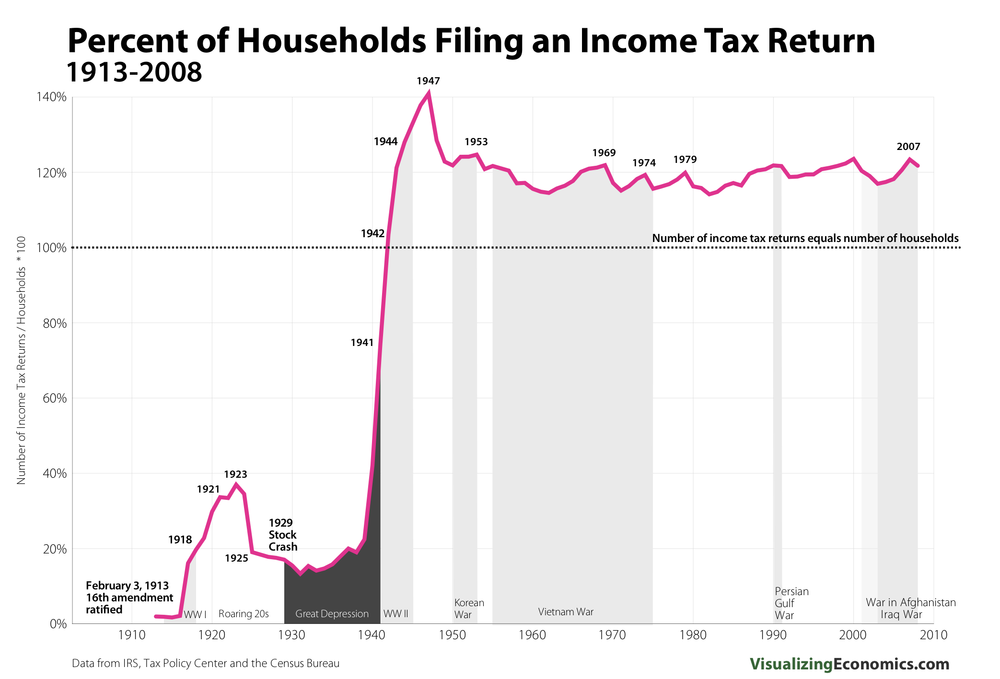
Clearly the early data is very sparse, in 1913 as low as 2% of households filed. Is it coincidental that the WW II era explosion of number of returns coincides with Piketty's chart that features a remarkably sharp decline in inequality? Or has Piketty pushed his chart beyond the reasonable limits of available data?
I don't have any particular insight into the sparseness of data for Piketty's second chart but the first chart tells me that somebody should check the numbers and ask the relevant question, whether the early portion of the data is as questionable as his first chart looks to my eyes. Piketty himself notes that his data is not as widespread as he would like it to be. It would have been responsible to add a line between the years of robust data availability and the zones where caution is warranted. It is a responsibility that Piketty seems uninterested in meeting. Perhaps such things will be added in a 2nd edition.
On page 27, Piketty errs when he says "the fundamental R > G inequality, the main force of divergence in my theory, has nothing to do with any market imperfection." There is a market imperfection. It is real. By saying that there is no market imperfection, Piketty is implicitly excluding the laboring class from joining the investor class and making an artificial barrier into a natural barrier. The laborer shall be the laborer and never a capitalist. The world does not work this way.
Piketty has to explain Andrew Carnegie, who started as a telegrapher and became one of his age's foremost capitalists as well as all the other famous and not so famous self-made men who have made the transition. From all I have read, he never addresses this change of role potential.
Piketty claims that the rapid growth of population in the US from 3M at the time of the Declaration of Independence, and the rapid growth of territory from the 13 colonies to the addition of Alaska and Hawaii in the 1950s make the US experience a non-generalizable outlier and that the correct model to look at the general world case is slow to expand France which only doubled its population during the same time period. The territory changes of France with the addition and subtraction of its colonial possessions is tastefully left out of the discussion. It likely would only confuse the narrative.
Of course by a priori excluding the US example as a model going forward, Piketty is cheating. He does not bother to prove his justification for excluding the US. It's just declare it as a non-generalizable outlier and move on.
I do agree with Piketty on the importance of gathering data and using the real world to inform and judge theories. A pretty theory that doesn't work and thus should be jettisoned is a global attitude that would have saved us from the gulag and would resolve the present problems of both North Korea and Cuba. But Piketty is only imperfectly applying his own standards here. He should be held strictly to them. For instance, he declares that the changes in US territory and demography lead it to be "no longer the same country". So how many countries is it and what is the data for each of those virtual countries? There is no data presented.
Does R > G indicate a shortage of capital or a surplus of capital? It would seem obvious to me that this status indicates a shortage, but the cure that Piketty prescribes would indicate that he believes that it indicates a surplus. You raise taxes on what you want less of. Perhaps I simply misunderstand and R > G can happen whether capital is in surplus or shortage, ie there is no relationship. I do not see how that can be true but I'm willing to be persuaded if Piketty ever gets around to addressing a small matter such as this.
This concludes my examination of Piketty's Introduction to Capital in the Twenty-First Century. I picked up the project because I had a surplus of time on my hands as I was waiting for some very long database reindexes. If this occurs again, I may pick up the book and proceed further but for now this will be the end of this series.
Sunday, June 8, 2014
Piketty's Introduction - Part III
This is a four part series going through Thomas Piketty's Capital in the 21st Century the parts can be found here:
Part I, Part II, Part III, Part IV
After only suspecting it from press accounts, picking up Piketty's Capital in the Twenty-First Century has convinced me by the second paragraph of its introduction that it desperately needs a thorough fisking. I'm picking up here from page 15 on the introduction.
On page 15 there's an interesting concept introduced of "inequalities at the global level" that leaves me scratching my head. China "may well prove to be a potent force for reducing inequalities on the global level" but isn't China's turning towards capitalism mean that its headed towards more inequality? What is different (superior?) about the Chinese road towards the market? Before Deng, what was China's role regarding inequality on a global level? I would hope that Piketty explores this more fully later. We'll see.
The idea that you can make any sort of straight line trends in global economics last 35 years, much less 85 years with a straight face is in my mind, well, naive at best. But Piketty goes for it even as he makes sure to inject enough uncertainty in his projections to make this statement meaningful. In other words, he's dog whistling about the world ending up being owned due to the straight line projection across several decades. If anybody of influence were to call him on this, no doubt he would retreat, and quickly. From the media appearances I've observed, he's obviously not enough of an idiot to defend such a declaration, though he is enough of one to have made it in the first place.
An interesting assumption embedded in Piketty's snark about Solow and Kuznets "balanced growth path" is that the rich world is advanced in the sense that Solow and Kuznets meant. That's not actually proven. For instance in the 1970s, the US made a retrograde move that established an oligarchy in bond rating agencies, one that continues to this day. How many other retrograde moves have been made and what does that mean in the sense of the Kuznets curve? There's plenty of pages to go and perhaps Piketty addresses this later but it is as absurd to assume that capitalism is a one way road. As Newsweek famously observed in 2009 "we are all socialists now." Has this socialism turned back the clock on the Kuznets curve? Is that even on Piketty's radar?
The 19th century economists, especially Marx, underestimated the mobility of people to change roles when the legal system permits them to and the economic system incentivises them to. Our economy would be more balanced if we made these role transitions easier. In reality the forces influencing these role transitions are decidedly mixed with considerable government pressure making them harder. We have, just to take one example, qualified investor rules limiting certain investment opportunities only to the well off that are completely out of place in a world that has undergone an information revolution.
There's a four page run where Piketty is acknowledging his colleagues and making a few technical points. Nothing to complain about there, and thank goodness for pacing issues in this analysis.
But page 20 has a bit of interesting caution to not accept any economic determinism, walking back Piketty's page 15 straight line analysis about who will own the world in 2050 or 2100. Piketty anticipates critics and refutes himself.
Piketty asserts that "there is no natural, spontaneous process to prevent destabilizing, inegalitarian forces from prevailing permanently." This is wrong as there is a powerful one, human nature. Those who are rich tend towards complacency and those who are poor tend towards activity. You have to work hard to beat the poor down into giving up, especially in a world of cheap information and huge gaping holes of unfulfilled goods and services. As this is a major result of the study that the book is based on, Piketty is in trouble long before he pulls out his first spreadsheet because, like Marx, he doesn't get people right. Let us hope it is with less momentous consequences.
It is really breathtaking, Piketty's idea that the market has little to do with the catch up in economies that are happening in a number of formerly poor economies. A key portion of the "process of the diffusion and sharing of knowledge" that is driving that catch up is that markets work and it is wise to dismantle the legal structures that prohibited or restricted markets in these countries. But for Piketty, that sort of knowledge diffusion is a priori not important.
In the forces of convergence section, there is a great elephant of a void, one that is quite noticeable if you don't have Piketty's sort of ideological blinders on. Over time, if you are prudent, you can move from being a laborer to a capitalist, and it would be normal that there are a large number of people who gain income from doing both and shifting emphasis from one to another as a counterbalancing force, chasing the better deal.
If capitalist activities are where the money is, there would be a natural tendency to increase effort in those areas and to divert income to investments, bidding up the prices and thus reducing the returns on capital. The sort of world where there's a tiny class of investors and everybody else gets all their income from labor is simply not today's world. This is exactly the sort of evolution that supports the Kuznets curve. That we're presently sabotaging this evolution via a huge creation of moral hazard by central banks and other policy stupidities does not change the underlying reality that humans tend to follow the money when it comes to earning their daily bread and Piketty's book is largely devoted to the proposition that they do not.
If you give short shrift to and do not accurately list the forces for convergence, of course they will look weak and easily overcome by forces for divergence. Again, this is an argument that does not depend on Piketty's statistics being in error, though the argument would be consistent with the errors that the FT found in its analysis.
Once again, I have reached the point where it is too long to go much further on a blog post and will try to pick things up again later.
Part I, Part II, Part III, Part IV
After only suspecting it from press accounts, picking up Piketty's Capital in the Twenty-First Century has convinced me by the second paragraph of its introduction that it desperately needs a thorough fisking. I'm picking up here from page 15 on the introduction.
On page 15 there's an interesting concept introduced of "inequalities at the global level" that leaves me scratching my head. China "may well prove to be a potent force for reducing inequalities on the global level" but isn't China's turning towards capitalism mean that its headed towards more inequality? What is different (superior?) about the Chinese road towards the market? Before Deng, what was China's role regarding inequality on a global level? I would hope that Piketty explores this more fully later. We'll see.
The idea that you can make any sort of straight line trends in global economics last 35 years, much less 85 years with a straight face is in my mind, well, naive at best. But Piketty goes for it even as he makes sure to inject enough uncertainty in his projections to make this statement meaningful. In other words, he's dog whistling about the world ending up being owned due to the straight line projection across several decades. If anybody of influence were to call him on this, no doubt he would retreat, and quickly. From the media appearances I've observed, he's obviously not enough of an idiot to defend such a declaration, though he is enough of one to have made it in the first place.
An interesting assumption embedded in Piketty's snark about Solow and Kuznets "balanced growth path" is that the rich world is advanced in the sense that Solow and Kuznets meant. That's not actually proven. For instance in the 1970s, the US made a retrograde move that established an oligarchy in bond rating agencies, one that continues to this day. How many other retrograde moves have been made and what does that mean in the sense of the Kuznets curve? There's plenty of pages to go and perhaps Piketty addresses this later but it is as absurd to assume that capitalism is a one way road. As Newsweek famously observed in 2009 "we are all socialists now." Has this socialism turned back the clock on the Kuznets curve? Is that even on Piketty's radar?
The 19th century economists, especially Marx, underestimated the mobility of people to change roles when the legal system permits them to and the economic system incentivises them to. Our economy would be more balanced if we made these role transitions easier. In reality the forces influencing these role transitions are decidedly mixed with considerable government pressure making them harder. We have, just to take one example, qualified investor rules limiting certain investment opportunities only to the well off that are completely out of place in a world that has undergone an information revolution.
There's a four page run where Piketty is acknowledging his colleagues and making a few technical points. Nothing to complain about there, and thank goodness for pacing issues in this analysis.
But page 20 has a bit of interesting caution to not accept any economic determinism, walking back Piketty's page 15 straight line analysis about who will own the world in 2050 or 2100. Piketty anticipates critics and refutes himself.
Piketty asserts that "there is no natural, spontaneous process to prevent destabilizing, inegalitarian forces from prevailing permanently." This is wrong as there is a powerful one, human nature. Those who are rich tend towards complacency and those who are poor tend towards activity. You have to work hard to beat the poor down into giving up, especially in a world of cheap information and huge gaping holes of unfulfilled goods and services. As this is a major result of the study that the book is based on, Piketty is in trouble long before he pulls out his first spreadsheet because, like Marx, he doesn't get people right. Let us hope it is with less momentous consequences.
It is really breathtaking, Piketty's idea that the market has little to do with the catch up in economies that are happening in a number of formerly poor economies. A key portion of the "process of the diffusion and sharing of knowledge" that is driving that catch up is that markets work and it is wise to dismantle the legal structures that prohibited or restricted markets in these countries. But for Piketty, that sort of knowledge diffusion is a priori not important.
In the forces of convergence section, there is a great elephant of a void, one that is quite noticeable if you don't have Piketty's sort of ideological blinders on. Over time, if you are prudent, you can move from being a laborer to a capitalist, and it would be normal that there are a large number of people who gain income from doing both and shifting emphasis from one to another as a counterbalancing force, chasing the better deal.
If capitalist activities are where the money is, there would be a natural tendency to increase effort in those areas and to divert income to investments, bidding up the prices and thus reducing the returns on capital. The sort of world where there's a tiny class of investors and everybody else gets all their income from labor is simply not today's world. This is exactly the sort of evolution that supports the Kuznets curve. That we're presently sabotaging this evolution via a huge creation of moral hazard by central banks and other policy stupidities does not change the underlying reality that humans tend to follow the money when it comes to earning their daily bread and Piketty's book is largely devoted to the proposition that they do not.
If you give short shrift to and do not accurately list the forces for convergence, of course they will look weak and easily overcome by forces for divergence. Again, this is an argument that does not depend on Piketty's statistics being in error, though the argument would be consistent with the errors that the FT found in its analysis.
Once again, I have reached the point where it is too long to go much further on a blog post and will try to pick things up again later.
Saturday, June 7, 2014
Piketty's Introduction - Part II
This is a four part series going through Thomas Piketty's Capital in the 21st Century the parts can be found here:
Part I, Part II, Part III, Part IV
After only suspecting it from press accounts, picking up Piketty's Capital in the Twenty-First Century has convinced me by the second paragraph of its introduction that it desperately needs a thorough fisking. I'm picking up here from page 7 on the introduction.
Wages are not hard linked to economic growth in capitalism. Wages are an epiphenomenon of the supply and demand of labor. With the countryside emptying out in a rush during the early industrial revolution, capital and labor became strongly unbalanced. The reasons for this were good. Increased yields from new technology led to less starvation and less need for farm labor. Unsurprisingly this led to low and stagnant wages at the urban receiving end until this huge wave of labor was absorbed and capital pools grew to a level that led to the bidding up of wages as capitalists had to start to compete for workers in a more serious way. Nobody who has gotten past undergraduate economics should be surprised, yet Professor Piketty seems surprised writing about the period "[t]his long period of wage stagnation, which we observe in Britain as well as France, stands out all the more because economic growth was accelerating in this period." This seems to be coming from a milieu of social justice and not economics. That would be fine if this were not an economics book. Or is it?
On page 9, Piketty passes over one of the greatest failures of Marx, the pretense that his vision of communism was scientific. A scientific communism is a communism that runs an experiment and when the experiment fails, it stops. Marxism never stops. It just gets new excuses.
It's only page 10 and Piketty seems to be undermining one of his previous statements that inequality inevitably leads to violence with the observation that inequality still was increasing in WW I but since wages were catching up, the spectre of proletarian revolution was receding in the advanced industrialized world. Is this what he means by "modern" economic growth? There's nothing particularly modern about absorbing and correcting a surplus of labor with the creation of new enterprises to occupy them.
Piketty is once again unduly kind to Marx by excusing his failure on a lack of statistical information. "If only the [great man] had known" is the cry of suckers who believe in failed systems and Piketty is engaging in that a bit here. It is particularly relevant to note that Marx's labor theory of value does not work. Marx raised important questions. So can a five year old. Such an act, unaccompanied by correct answers is not the stuff of greatness. Here Marx, have a cookie for asking an interesting question. Now go stand in the corner of historical villainy for making the gulag possible. Piketty has lousy taste.
Accumulated wealth is ultimately of two sources, gathered and/or maintained by violence or gathered/maintained by skill. The former is to be condemned and fought against. The latter is intergenerationally unreliable (ie over the scale of time that generates social instability). Societal measures should target only the first. Piketty's preferred solution to the problem targets both. People do not go out into the streets to fight against Bill Gates riches in relevant numbers because manifestly he is doing a world of good, as do many of his peers. The Democrat party's obsession with the Koch brothers is relevant here. Explaining both why the Democrats have made them their great white whale and why ultimately it's not giving them the political traction they hoped.
Piketty is in love with statistics and so I see why he might think that income tax is "useful for establishing classifications and promoting knowledge as well as democratic transparency" in his discussion on Kuznets. The usefulness of this information is a bit counterbalanced by the enabling effect on envy and the almost inevitable reduction of societal solidarity. Pity he doesn't mention those effects. They must not fit his narrative. In a book devoted to the ill effects of inequality, it's a little surprising that he's overlooking this contribution to those ill effects.
Kuznets, with his eponymous curve, seems to be the big elephant that Piketty is aiming at. He calls it "magical", a term not usually professionally complimentary. Kuznets must be discredited for Piketty's thesis of dangerously growing inequality to have a chance. The Kuznets curve was "a product of the Cold War" which implies but does not say that it is wrong. The moon landing was a product of the Cold War. Does Piketty cast doubt on that because of its provenance too? Let's try it on for size, the "magical Kuznets curve" matched by the magical moon landing? I think not.
The Kuznets curve will stand or fall as we end up in a sufficiently long period without huge exogenous shocks that mask the effect if it's present. Piketty's snark doesn't move the conversation along.
Once again this is getting too long for a blog post. If I keep up this pace of analysis, I will be posting another 81 posts on this book. I may have to take lessons from Stephen Green towards the end. I don't think I'm going to make it in six more days. As annoying as finding these problems in Piketty's work, the thing is intellectually stimulating, probably in ways that Piketty didn't intend. For instance, it seems like under Piketty's analysis of global inequality, communism was anti-egalitarian. Now that would be an interesting interview question for Piketty but unlikely one that he would face.
Part I, Part II, Part III, Part IV
After only suspecting it from press accounts, picking up Piketty's Capital in the Twenty-First Century has convinced me by the second paragraph of its introduction that it desperately needs a thorough fisking. I'm picking up here from page 7 on the introduction.
Wages are not hard linked to economic growth in capitalism. Wages are an epiphenomenon of the supply and demand of labor. With the countryside emptying out in a rush during the early industrial revolution, capital and labor became strongly unbalanced. The reasons for this were good. Increased yields from new technology led to less starvation and less need for farm labor. Unsurprisingly this led to low and stagnant wages at the urban receiving end until this huge wave of labor was absorbed and capital pools grew to a level that led to the bidding up of wages as capitalists had to start to compete for workers in a more serious way. Nobody who has gotten past undergraduate economics should be surprised, yet Professor Piketty seems surprised writing about the period "[t]his long period of wage stagnation, which we observe in Britain as well as France, stands out all the more because economic growth was accelerating in this period." This seems to be coming from a milieu of social justice and not economics. That would be fine if this were not an economics book. Or is it?
On page 9, Piketty passes over one of the greatest failures of Marx, the pretense that his vision of communism was scientific. A scientific communism is a communism that runs an experiment and when the experiment fails, it stops. Marxism never stops. It just gets new excuses.
It's only page 10 and Piketty seems to be undermining one of his previous statements that inequality inevitably leads to violence with the observation that inequality still was increasing in WW I but since wages were catching up, the spectre of proletarian revolution was receding in the advanced industrialized world. Is this what he means by "modern" economic growth? There's nothing particularly modern about absorbing and correcting a surplus of labor with the creation of new enterprises to occupy them.
Piketty is once again unduly kind to Marx by excusing his failure on a lack of statistical information. "If only the [great man] had known" is the cry of suckers who believe in failed systems and Piketty is engaging in that a bit here. It is particularly relevant to note that Marx's labor theory of value does not work. Marx raised important questions. So can a five year old. Such an act, unaccompanied by correct answers is not the stuff of greatness. Here Marx, have a cookie for asking an interesting question. Now go stand in the corner of historical villainy for making the gulag possible. Piketty has lousy taste.
Accumulated wealth is ultimately of two sources, gathered and/or maintained by violence or gathered/maintained by skill. The former is to be condemned and fought against. The latter is intergenerationally unreliable (ie over the scale of time that generates social instability). Societal measures should target only the first. Piketty's preferred solution to the problem targets both. People do not go out into the streets to fight against Bill Gates riches in relevant numbers because manifestly he is doing a world of good, as do many of his peers. The Democrat party's obsession with the Koch brothers is relevant here. Explaining both why the Democrats have made them their great white whale and why ultimately it's not giving them the political traction they hoped.
Piketty is in love with statistics and so I see why he might think that income tax is "useful for establishing classifications and promoting knowledge as well as democratic transparency" in his discussion on Kuznets. The usefulness of this information is a bit counterbalanced by the enabling effect on envy and the almost inevitable reduction of societal solidarity. Pity he doesn't mention those effects. They must not fit his narrative. In a book devoted to the ill effects of inequality, it's a little surprising that he's overlooking this contribution to those ill effects.
Kuznets, with his eponymous curve, seems to be the big elephant that Piketty is aiming at. He calls it "magical", a term not usually professionally complimentary. Kuznets must be discredited for Piketty's thesis of dangerously growing inequality to have a chance. The Kuznets curve was "a product of the Cold War" which implies but does not say that it is wrong. The moon landing was a product of the Cold War. Does Piketty cast doubt on that because of its provenance too? Let's try it on for size, the "magical Kuznets curve" matched by the magical moon landing? I think not.
The Kuznets curve will stand or fall as we end up in a sufficiently long period without huge exogenous shocks that mask the effect if it's present. Piketty's snark doesn't move the conversation along.
Once again this is getting too long for a blog post. If I keep up this pace of analysis, I will be posting another 81 posts on this book. I may have to take lessons from Stephen Green towards the end. I don't think I'm going to make it in six more days. As annoying as finding these problems in Piketty's work, the thing is intellectually stimulating, probably in ways that Piketty didn't intend. For instance, it seems like under Piketty's analysis of global inequality, communism was anti-egalitarian. Now that would be an interesting interview question for Piketty but unlikely one that he would face.
Friday, June 6, 2014
Piketty's Introduction - Part I
This is a four part series going through Thomas Piketty's Capital in the 21st Century the parts can be found here:
Part I, Part II, Part III, Part IV
Piketty's introduction is the first problem with the book. He manages to get through paragraph one without serious problems but can't manage to extend that record to paragraph two.
Piketty claims
It's only the introduction but it's not looking good so far. Piketty has already revealed that he is assuming his conclusions.
It gets worse
An illustration should suffice. Take a room full of poor entrepreneurs. Add exactly one money bags investor. The economy will rely on the investor to supply virtually all the capital. Assume that out of 100 business proposals he funds 10 and being the only game in town he does so at quite advantageous terms to himself. 1 is a 100x investment success, 6 are variously successful averaging 4x return, and 3 go bust. The return to capital is clearly going to be greater than economic growth in this situation. But the 100x successful business yields enough money in the heretofore poor entrepreneurs hands that he can fund a venture all by himself and the 6 entrepreneurs can fund another 2 if they act together. The next funding round sees essentially 4 money bags and more businesses being funded. Each subsequent round will see less and less lopsided terms being granted the entrepreneurs. After all, they can play one investor off against another. More and more of the poor entrepreneurs will either propose or be part of a successful team. More and more deals will be self-financed. Eventually you get to a balance. This is the deep structure of capitalism and it is very different from what Piketty is assuming.
Now add Piketty's famous wealth tax and what happens. The money bags won't be investing in 10 businesses, but 7, the balance of his funds being absorbed by tax shelters and lobbying for loopholes in the wealth tax (which empirical observation leads us to guess that he will get but that it absorbs a large amount of time, effort, and money). The 100x entrepreneur winner in the first round might still be comfortable but likely not enough to fund the same sort of venture as before and the medium sized winners are fewer and even less capable of enlarging the pool of investors and increasing the fairness of terms in the next round of investment in business.
Piketty is trying to claim a moral high ground as early as page 1 but unfortunately for him, he is a policy villain. He seems to ignore that R > G is a price signal. This price signal is an encouragement to enter the field of capitalist and invest. Taxing the wealthy is a strong signal not to invest too much, diverting resources.
Piketty claims that "violent political conflict" is something that "inequality inevitably instigates". I look forward to seeing the data that proves this claim because I do not believe it to be true. Comfortable members of the middle class are not going to be going out into the streets because the rich are getting more comfortable faster. They are especially not going to be doing it when the path to their own riches clearly remains open if they wish to exert themselves. Inequality, per se, does not lead to violence. Additional factors have to be present.
I'll leave a placeholder here regarding Piketty's discussion on oil prices and urban land as he explicitly says that he'll provide a nuanced discussion later. Suffice to say his introductory remarks do not instill confidence. That the Chinese have (wisely or foolishly) built many empty cities demonstrates that increasing the supply of urban land is not that difficult. As for oil, there is a ceiling price to oil, and it's dropping. Fischer Tropsch plants can convert other hydrocarbons to liquid fuels. So long as the extensive investment costs can be recovered, a persistent level of high oil prices is simply not going to happen and that is putting aside the more exotic substitute goods of electric and fuel cell powered vehicles.
We are barely into page 7 of a 35 page introduction and this is already getting long for a blog post so I will stop here and add a 'part I' to my title.
Update: Piketty partially addresses the issue of substitute goods in footnote 3. I say partially because he claims that finding these substitute goods "can take decades to accomplish" which is weasel wording at best. Modern economies research pieces of substitute goods, often decades before they are generally needed and leave the results in patent offices and scientific journal, dormant until we approach the conditions where they become practical whereupon the vision of riches leads to their resurrection more often than not. Large price swings actually create a positive influence in this process as can be seen in the fits and starts refinement process that has made Fischer Tropsch a practical substitute good for drilling oil. At this point, it is only the long lead times for recouping investment and the uncertainty of how quickly other substitute goods for transportation fuel will emerge that are holding back this technology.
it's become clear to me that footnotes are where Piketty is going to be burying the inconvenient facts he must cover to save his reputation while minimizing the number of people who actually walk away with an appreciation of those facts. This is not quite an approach that is devoted to the honest search for truth.
Part I, Part II, Part III, Part IV
Piketty's introduction is the first problem with the book. He manages to get through paragraph one without serious problems but can't manage to extend that record to paragraph two.
Piketty claims
Modern economic growth and the diffusion of knowledge have made it possible to avoid the Marxist apocalypse but have not modified the deep structures of capital and inequality.But that's just not right. What is it about modern economic growth that makes it Marx bane as opposed to pre-modern economic growth? Piketty doesn't say up front. Perhaps later, but there doesn't seem to be much discussion of it uncovered by a Google search. The concept of a magical 'modern' economic growth doesn't make much sense. The diffusion of knowledge makes a very vague reference to the real issue of R > G but not in a particularly helpful way. Isn't the very existence of deep structures of capital and inequality the question that Piketty is putatively seeking to answer, ie whether Marx was right all along?
It's only the introduction but it's not looking good so far. Piketty has already revealed that he is assuming his conclusions.
It gets worse
When the rate of return on capital exceeds the rate of growth of output and income... capitalism automatically generates arbitrary and unsustainable inequalities that radically undermine the meritocratic values on which democratic societies are based.This is simply not true. You have to have an additional factor for an undermining effect to take place. You have to limit the conversion of individuals who live via labor to individuals who earn a living via capital. There are plenty of people who work to pull up the ladder that enables this conversion but they do not generally reside among the advocates of laissez faire. Piketty's advertised solution, a heavy wealth tax, pulls up the ladder quite effectively. This makes Piketty a decided villain by his own R > G standards.
An illustration should suffice. Take a room full of poor entrepreneurs. Add exactly one money bags investor. The economy will rely on the investor to supply virtually all the capital. Assume that out of 100 business proposals he funds 10 and being the only game in town he does so at quite advantageous terms to himself. 1 is a 100x investment success, 6 are variously successful averaging 4x return, and 3 go bust. The return to capital is clearly going to be greater than economic growth in this situation. But the 100x successful business yields enough money in the heretofore poor entrepreneurs hands that he can fund a venture all by himself and the 6 entrepreneurs can fund another 2 if they act together. The next funding round sees essentially 4 money bags and more businesses being funded. Each subsequent round will see less and less lopsided terms being granted the entrepreneurs. After all, they can play one investor off against another. More and more of the poor entrepreneurs will either propose or be part of a successful team. More and more deals will be self-financed. Eventually you get to a balance. This is the deep structure of capitalism and it is very different from what Piketty is assuming.
Now add Piketty's famous wealth tax and what happens. The money bags won't be investing in 10 businesses, but 7, the balance of his funds being absorbed by tax shelters and lobbying for loopholes in the wealth tax (which empirical observation leads us to guess that he will get but that it absorbs a large amount of time, effort, and money). The 100x entrepreneur winner in the first round might still be comfortable but likely not enough to fund the same sort of venture as before and the medium sized winners are fewer and even less capable of enlarging the pool of investors and increasing the fairness of terms in the next round of investment in business.
Piketty is trying to claim a moral high ground as early as page 1 but unfortunately for him, he is a policy villain. He seems to ignore that R > G is a price signal. This price signal is an encouragement to enter the field of capitalist and invest. Taxing the wealthy is a strong signal not to invest too much, diverting resources.
Piketty claims that "violent political conflict" is something that "inequality inevitably instigates". I look forward to seeing the data that proves this claim because I do not believe it to be true. Comfortable members of the middle class are not going to be going out into the streets because the rich are getting more comfortable faster. They are especially not going to be doing it when the path to their own riches clearly remains open if they wish to exert themselves. Inequality, per se, does not lead to violence. Additional factors have to be present.
I'll leave a placeholder here regarding Piketty's discussion on oil prices and urban land as he explicitly says that he'll provide a nuanced discussion later. Suffice to say his introductory remarks do not instill confidence. That the Chinese have (wisely or foolishly) built many empty cities demonstrates that increasing the supply of urban land is not that difficult. As for oil, there is a ceiling price to oil, and it's dropping. Fischer Tropsch plants can convert other hydrocarbons to liquid fuels. So long as the extensive investment costs can be recovered, a persistent level of high oil prices is simply not going to happen and that is putting aside the more exotic substitute goods of electric and fuel cell powered vehicles.
We are barely into page 7 of a 35 page introduction and this is already getting long for a blog post so I will stop here and add a 'part I' to my title.
Update: Piketty partially addresses the issue of substitute goods in footnote 3. I say partially because he claims that finding these substitute goods "can take decades to accomplish" which is weasel wording at best. Modern economies research pieces of substitute goods, often decades before they are generally needed and leave the results in patent offices and scientific journal, dormant until we approach the conditions where they become practical whereupon the vision of riches leads to their resurrection more often than not. Large price swings actually create a positive influence in this process as can be seen in the fits and starts refinement process that has made Fischer Tropsch a practical substitute good for drilling oil. At this point, it is only the long lead times for recouping investment and the uncertainty of how quickly other substitute goods for transportation fuel will emerge that are holding back this technology.
it's become clear to me that footnotes are where Piketty is going to be burying the inconvenient facts he must cover to save his reputation while minimizing the number of people who actually walk away with an appreciation of those facts. This is not quite an approach that is devoted to the honest search for truth.
Library Follies
My local library highly estimates the reading ability of Lake County, IN library patrons. They made Thomas Piketty's Capital in the Twenty First Century a seven day loan book. Not counting footnotes, it's a 577 page book.
I'll give it a shot.
I'll give it a shot.
Tuesday, April 29, 2014
Simple Question
With the rise of military policing, I've noticed something missing in the discussion, a comparison of law enforcement models. Nobody seems to be answering the question, for every particular jurisdiction, which of the three models available is best for fighting crime in that jurisdiction. The three models, in order of their invention, are hue and cry, peace officers, and military style policing. If you think the model list is too short, feel free to add to it in comments.
It's such a simple question, but nobody's asking it, nobody's answering it, and nobody's making adjustments to policing models in a systematic, scientific way. This is not rocket science. You don't need above average intelligence to do this task but people talk about the future where we'll have nothing to do and no way to earn our daily bread.
It's such a simple question, but nobody's asking it, nobody's answering it, and nobody's making adjustments to policing models in a systematic, scientific way. This is not rocket science. You don't need above average intelligence to do this task but people talk about the future where we'll have nothing to do and no way to earn our daily bread.
Tuesday, April 22, 2014
Multiplying fishes
We got 4.5 times the expected Pacific salmon run this year due to one weird trick. We (and by we I mean an eco entrepreneur named Russ George and a BC indian tribe, the Haida) strategically distributed 120 tons of iron sulfate in the Pacific and created an ocean paradise for the salmon to feed on. 12 men and one boat worked in 2012 to set up that feeding ground to reduce the traditional levels of starvation among migratory fish going out into the resource poor Pacific Ocean. Open-sea mariculture has been hemmed in by unfortunate treaty language that fails to distinguish between pollution and setting out fish food. The 2012 experiment results are in.
As a side effect of the process, a great deal of carbon dioxide was sequestered as the diatoms that did not get eaten by the fish died a natural death and sank to the bottom.
Environmentalists are beside themselves with fury. They're more interested in establishing a precautionary principle regulatory framework that would have led to many tons fewer fish to feed families across North America this year if not banning the process altogether. Their global campaign made the Haida blink and Mr. George has been fired.
We can't have fish multiplying beyond all reason and solving our global food problems while knocking down CO2 levels. That might reduce the need for environmental NGOs to study the problem.
The SE Alaska Pink catch in the fall of 2013 was a stunning 226.3 million fish. This when a high number of 50 million fish were expected. Those extra ocean pasture fed fish came back because their pasture was enjoying the richest plankton blooms ever, thanks to me a[nd] 11 shipmates and our work in the summer of 2012. IT JUST WORKS.
As a side effect of the process, a great deal of carbon dioxide was sequestered as the diatoms that did not get eaten by the fish died a natural death and sank to the bottom.
Environmentalists are beside themselves with fury. They're more interested in establishing a precautionary principle regulatory framework that would have led to many tons fewer fish to feed families across North America this year if not banning the process altogether. Their global campaign made the Haida blink and Mr. George has been fired.
We can't have fish multiplying beyond all reason and solving our global food problems while knocking down CO2 levels. That might reduce the need for environmental NGOs to study the problem.
Friday, April 11, 2014
Virtuous Capitalists
Are entrepreneurs virtuous? Here's an excellent (if long) video that lays out the issues.
The short version is that yes, entrepreneurs are virtuous when they profit from creating value, new products, services, as well as converging prices through arbitrage. Entrepreneurs are not virtuous when they rent seek, creating a legal system that forces people to give them money (or more money) based on a political decision influenced by lobbyists.
The weakness is that you can make good money by rent seeking in a debased political system that permits it. Any firm focused on creating value can add to its accounting profits by adding lobbyists to rent seek on behalf of the firm. This means that they are vulnerable to hostile takeover. The vulnerability to vicious rent seekers is only repaired by healing the political system so the rent seeking is denied in the political process.
The short version is that yes, entrepreneurs are virtuous when they profit from creating value, new products, services, as well as converging prices through arbitrage. Entrepreneurs are not virtuous when they rent seek, creating a legal system that forces people to give them money (or more money) based on a political decision influenced by lobbyists.
The weakness is that you can make good money by rent seeking in a debased political system that permits it. Any firm focused on creating value can add to its accounting profits by adding lobbyists to rent seek on behalf of the firm. This means that they are vulnerable to hostile takeover. The vulnerability to vicious rent seekers is only repaired by healing the political system so the rent seeking is denied in the political process.
Wednesday, February 12, 2014
Counting
We have never been more able to actually count things in the history of the world. No need to guess, estimate, or interpolate when you can actually count it all out. But we don't do it, or we don't do it as much as we could.
Where we can count, we should. Where we can ask, we should. I do not go a day without noting somebody assuming where they could measure, estimating where they could count. It is no longer functional behavior but the less and less functional legacy of the pre-information age. The faster we are rid of the habits of guesswork, the better.
Friday, February 7, 2014
Why Work Disincentives Matter
The usual partisan catfight has broken out again, this time because of a CBO report saying that Obamacare will destroy 2.3M jobs by 2021. It's disappointing to notice that both sides are ignoring the elephant in the room. There's work to be done.
There's snow to clear off the roads, fires to put out, garbage to be collected, potholes to be filled and all the other myriad things that governments do. A great deal of that is paid for by employment related taxes. Drop a few million jobs and the work is still there for the most part which means that the remaining working population is going to have a heavier load per capita.
The Democrats have an obvious interest in ignoring the basic facts. It destroys their chosen spin that people are liberated by not having to work.
It's much less clear why the GOP isn't mentioning it. They seem to be assuming that everybody understands this without having to explain it. That's a bad bet in today's information environment.
There are two ways to fix our unemployment problem. The first is to increase labor demand by legalizing work, reducing barriers to job creation and making company formation easier. The second is to reduce supply by making people less interested in going out and getting a job, leaving more jobs for the rest of us. The Obama administration seems just fine with the latter approach. That's unfortunate.
There's snow to clear off the roads, fires to put out, garbage to be collected, potholes to be filled and all the other myriad things that governments do. A great deal of that is paid for by employment related taxes. Drop a few million jobs and the work is still there for the most part which means that the remaining working population is going to have a heavier load per capita.
The Democrats have an obvious interest in ignoring the basic facts. It destroys their chosen spin that people are liberated by not having to work.
It's much less clear why the GOP isn't mentioning it. They seem to be assuming that everybody understands this without having to explain it. That's a bad bet in today's information environment.
There are two ways to fix our unemployment problem. The first is to increase labor demand by legalizing work, reducing barriers to job creation and making company formation easier. The second is to reduce supply by making people less interested in going out and getting a job, leaving more jobs for the rest of us. The Obama administration seems just fine with the latter approach. That's unfortunate.
Monday, February 3, 2014
Watching Al Jazeera
My father and I watched Al Jazeera America for the first time today. It was a pretty effective bit of brainwashing whose subject was cartoon journalism but whose purpose was all about promoting emotion over thought, emotion over reason. During a commercial break they advertised an upcoming show on immigration. It offended the both of us but, as is usual in our case, for different reasons.
My father saw one more rerun of the nasty propaganda machine he had to suffer under in communist Romania. He knew the truth because he had known witnesses. The witnesses told simple stories that revealed simple truths. The Soviets, for 20 years on the Nistru river would shoot attempted border crossers in the water and the Romanians would collect the bodies and the wounded as they drifted into Romanian territory. Later, they started shooting them before they got to the river as they hardened the border. My father's witnesses were Romanian border guards who, in peacetime, had to pick up the dead and wounded at a pace fit for a small war.
In those days, a Soviet border guard would get a bonus and 20 days vacation for shooting a would be crosser. If they were in need of funds or a break in routine, they would sometimes threaten a local peasant with death if they didn't walk into the no-go zone. The guard would then proceed to shoot them and collect.
It's not a story you hear too often. I knew at least one of those men as a child. He never mentioned this story to me, though he told me others.
Usually I don't pass on the really brutal stories but today I've overloaded on Soviet apologists claiming moral superiority. We do not have the moral filters to weed out these evil degenerates for mass murder as we do for their Nazi cousins. It's a shame that we don't.
The dead weep.
My father saw one more rerun of the nasty propaganda machine he had to suffer under in communist Romania. He knew the truth because he had known witnesses. The witnesses told simple stories that revealed simple truths. The Soviets, for 20 years on the Nistru river would shoot attempted border crossers in the water and the Romanians would collect the bodies and the wounded as they drifted into Romanian territory. Later, they started shooting them before they got to the river as they hardened the border. My father's witnesses were Romanian border guards who, in peacetime, had to pick up the dead and wounded at a pace fit for a small war.
In those days, a Soviet border guard would get a bonus and 20 days vacation for shooting a would be crosser. If they were in need of funds or a break in routine, they would sometimes threaten a local peasant with death if they didn't walk into the no-go zone. The guard would then proceed to shoot them and collect.
It's not a story you hear too often. I knew at least one of those men as a child. He never mentioned this story to me, though he told me others.
Usually I don't pass on the really brutal stories but today I've overloaded on Soviet apologists claiming moral superiority. We do not have the moral filters to weed out these evil degenerates for mass murder as we do for their Nazi cousins. It's a shame that we don't.
The dead weep.
Sunday, February 2, 2014
Government scoped in a rational world
In a rational world, we would recognize that the vast majority are neither communists or anarchists. Most people believe that the communist principle that everything must be done by the government is not valid and neither is the anarchist principle that nothing should be done by it. The details may differ but the bedrock is the same, we mostly believe in "it depends" government. This is actually a pragmatic way to approach the world as neither ideological pole is perfect.
Those who are closer to the communist will say that government dependability is important and only certain exceptions for private action should be done where it happens to be more efficient at present. The mirror image happens on the other side where liberty enthusiasts are all for private action with a few minor exceptions where government ends up being a better solution, for now.
Those who are closer to the communist will say that government dependability is important and only certain exceptions for private action should be done where it happens to be more efficient at present. The mirror image happens on the other side where liberty enthusiasts are all for private action with a few minor exceptions where government ends up being a better solution, for now.
I'm pretty clear about where I personally think the sweet spot is, which is a lot closer to no government than all intrusive government and the sweet spot is moving further away from government as the best solution as time goes by and people actually do the hard detail work of privately solving the problems that traditionally have been handled by government. Every time we shift the other direction we seem to trade off long term sustainability and utility for a quick short term jump in utility. That's acceptable in an emergency but only so long as we periodically review and remove these bandaids when the emergency is over. The problem is, we don't.
We need to build out a capacity and a procedure to periodically review what government does in a sustainable way. We are missing some of the most basic tools to do the job. It's not like it's illegal, hard, or even very expensive to do it. What it is is frustrating and tedious.
Saturday, February 1, 2014
Rethink telecommuting
The Indiana State Police have an email notification system set up and lately with all the bad weather around here have been hammering a constant refrain, "rethink your trip", encouraging people not to go out into the snowy, slippery conditions if at all possible and slowing down, increasing distances and driving conservatively.
This is all well and good for those who can afford to skip trips but the number of people out on the road could have been much lower if we had thought ahead and made better arrangements to support telecommuting. Increasing the number of people working from home creates fewer people who have to go out into the snow regardless of the weather. Laying in the infrastructure to increase telecommuting is a long term solution that takes foresight and guts. It involves some fundamental changes in the way we do business, especially in the white collar world, which is the vast majority of telecommuting potential.
This is all well and good for those who can afford to skip trips but the number of people out on the road could have been much lower if we had thought ahead and made better arrangements to support telecommuting. Increasing the number of people working from home creates fewer people who have to go out into the snow regardless of the weather. Laying in the infrastructure to increase telecommuting is a long term solution that takes foresight and guts. It involves some fundamental changes in the way we do business, especially in the white collar world, which is the vast majority of telecommuting potential.
Sunday, January 12, 2014
Etiquette question
What is the appropriate conversational response at a party to "the suicide bomber almost got me"?
Discuss.
Discuss.
Thursday, January 9, 2014
The White Ghetto
Pope Francis' indictment of welfare applies to the US. For me the takeaway line from Kevin D Williamson's The White Ghetto is “The government gives people checks, but nobody teaches them how to live” and a sad takeaway indeed.
There is no cure for the sort of hopelessness this article shows that does not start with love and caring for individuals and creating a plan to get them out of the welfare and cultural trap that they are in.
There is no cure for the sort of hopelessness this article shows that does not start with love and caring for individuals and creating a plan to get them out of the welfare and cultural trap that they are in.
Subscribe to:
Posts (Atom)